

Most manufacturing companies running Windchill will tell you they already have some kind of connection with their ERP. And technically, they are right. Data moves between the two systems. BOMs get transferred. Item lists are updated. Engineering changes eventually make their way into production.
The question is how.
In the vast majority of small and mid-sized industrial companies, the answer is the same: someone exports data from Windchill into a spreadsheet, works on it, and uploads it into the ERP. Or the other way around. Sometimes with a bit of scripting on top. Sometimes entirely by hand.
That is not an integration. That is a workaround that has become invisible because everyone has learned to live with it.
How spreadsheet-based transfers become the standard
This is not a criticism of the people who set it up. When a company first implements Windchill and an ERP, a full real-time integration is rarely the priority. There is a go-live deadline, a limited budget, and a team that needs to start working. Someone figures out a process using export files, it works well enough, and it becomes the de facto method.
Years later, that same process is still running. It has been documented, it has been handed from one person to the next, and it has become so embedded in daily operations that nobody questions it anymore. It is just how things work here.
The problem is not the spreadsheet itself. The problem is what happens when the business grows, the product catalogue expands, the pace of engineering changes accelerates, and the volume of data that needs to move between systems increases. What was manageable at fifty items becomes a liability at five hundred.
The real cost of moving data through files
Spreadsheet-based transfers between Windchill and ERP create a specific set of problems that rarely show up in a single dramatic failure. They accumulate quietly, in the background, until they become impossible to ignore.
Version mismatches
By the time a file is exported, processed, reviewed and imported into the ERP, the source data in Windchill may have already changed. Engineering revisions move faster than manual transfer cycles. Production ends up working from a BOM that is one or two iterations behind the current design — and in many cases, nobody knows until something goes wrong on the shop floor.
Human error at every step
Every manual intervention in the transfer process is a potential point of failure. A column mapped incorrectly. A row accidentally deleted. A filter applied to the wrong field. These are not exceptional events. They are routine, and they have routine consequences: rework, incorrect procurement orders, and inventory built around obsolete configurations.
Dependency on specific people
In most companies using this model, the transfer process is only fully understood by one or two individuals. When those people are unavailable — on holiday, sick, or simply gone — the process slows down or stops entirely. The organization has built a critical operational dependency around a manual routine.
No traceability
When data moves through a spreadsheet, the audit trail disappears. If a BOM error is discovered three months later, tracing it back to a specific file version, a specific transfer, or a specific decision is extremely difficult. For companies operating in regulated industries or with strict quality requirements, this is not just an inconvenience — it is a compliance risk.
The time nobody accounts for
Someone has to prepare the file, validate it, send it, confirm receipt, and troubleshoot when something does not match. This work does not show up in any integration budget because it is absorbed by the team as part of their normal workload. But it represents real hours, every week, spent on data logistics instead of engineering or operations.
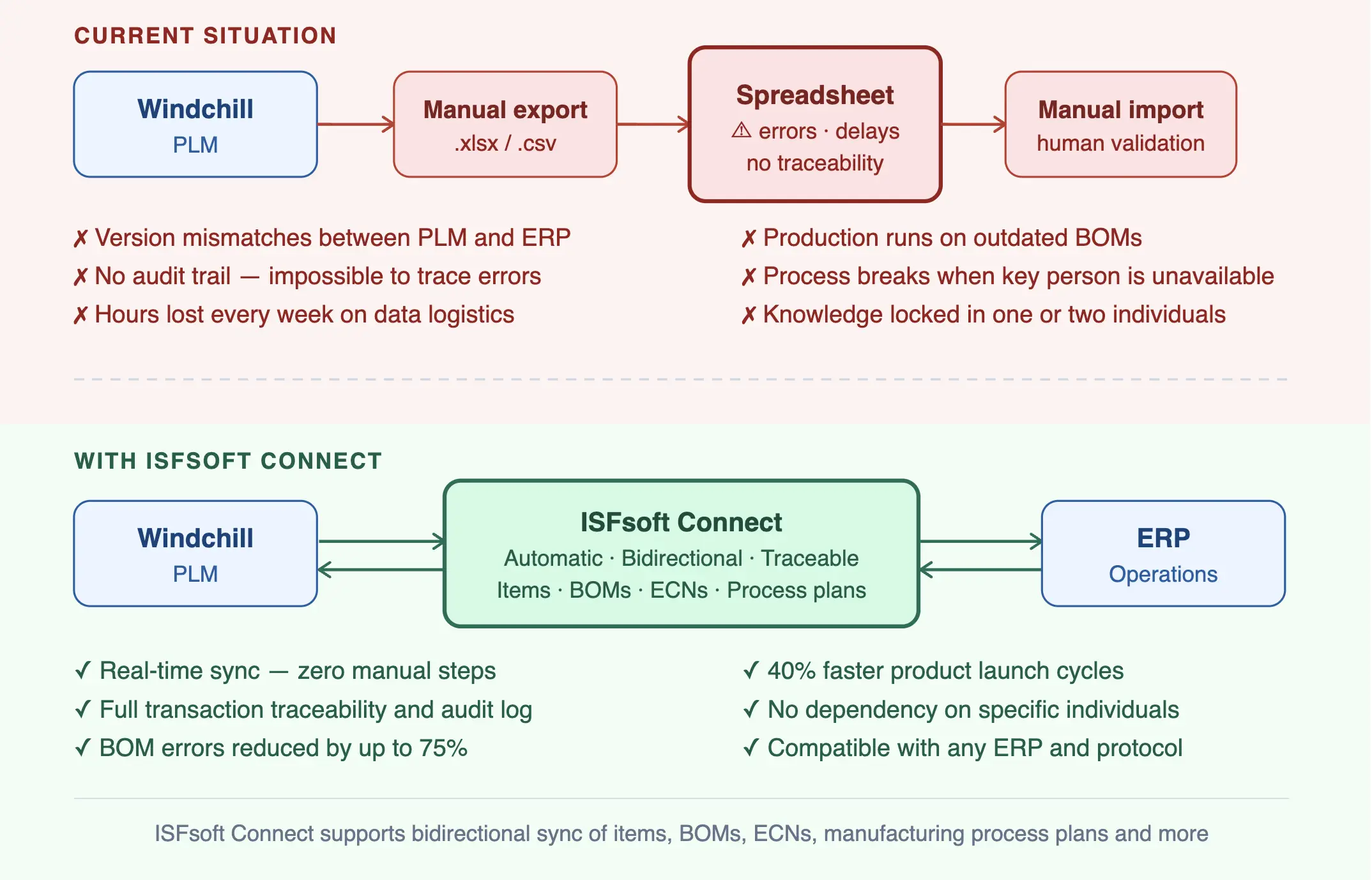
Spreadsheet-based transfer vs. real-time integration with ISFsoft Connect
When the workaround stops working
There are usually clear signals that the spreadsheet transfer model has reached its limit, even if they are not immediately recognized as integration problems.
Engineering change cycles slow down because the effort required to push changes through to ERP creates a bottleneck. Product launches take longer than they should because teams spend days reconciling data before anyone can commit to a manufacturing plan. Quality incidents increase and trace back to BOM inconsistencies between what engineering defined and what production received. And the people managing the transfer process start spending more and more time on it, with less and less time for anything else.
At this point, the question is no longer whether to improve the integration. The question is how long the organization can afford to wait.
What a real integration between Windchill and ERP looks like
A proper integration does not mean replacing the spreadsheet with a more sophisticated spreadsheet. It means eliminating the manual transfer step entirely.
When Windchill and ERP are connected through a dedicated integration layer, product data flows automatically and in a controlled way. New items created in Windchill are reflected in ERP without manual intervention. BOM structures and revisions are synchronized as soon as they are released. Engineering Change Notices trigger the corresponding updates in ERP in real time. And every transaction is logged, traceable and auditable.
The operational impact is significant. Version mismatches disappear because there is no delay between the source data and the downstream system. Errors caused by manual handling are eliminated. The people who were managing the transfer process are freed to do higher-value work. And the organization gains a level of operational confidence in its data that simply does not exist when spreadsheets are in the middle.
ISFsoft Connect: built for Windchill environments
ISFsoft Connect is an integration platform designed specifically to connect Windchill PLM with ERP systems. It works as an Enterprise Service Bus, managing the synchronization of product data, engineering structures and operational information between both platforms in a controlled, bidirectional and traceable way.
The processes it supports cover the full scope of what companies currently manage through manual transfers: item creation and updates, BOM synchronization, Engineering Change Notice and ECO flows, manufacturing process plans, and option and variant expressions. All of it automated. All of it logged.
ISFsoft Connect also handles the heterogeneity that is typical in real industrial environments — different ERP systems, different data formats, different protocols — without requiring companies to standardize their entire technology stack first.
The result is an integration that does not depend on a spreadsheet, does not depend on a specific person, and does not introduce a manual step between what engineering defines and what operations receives.
If your Windchill–ERP connection currently runs through files, that is where to start.