


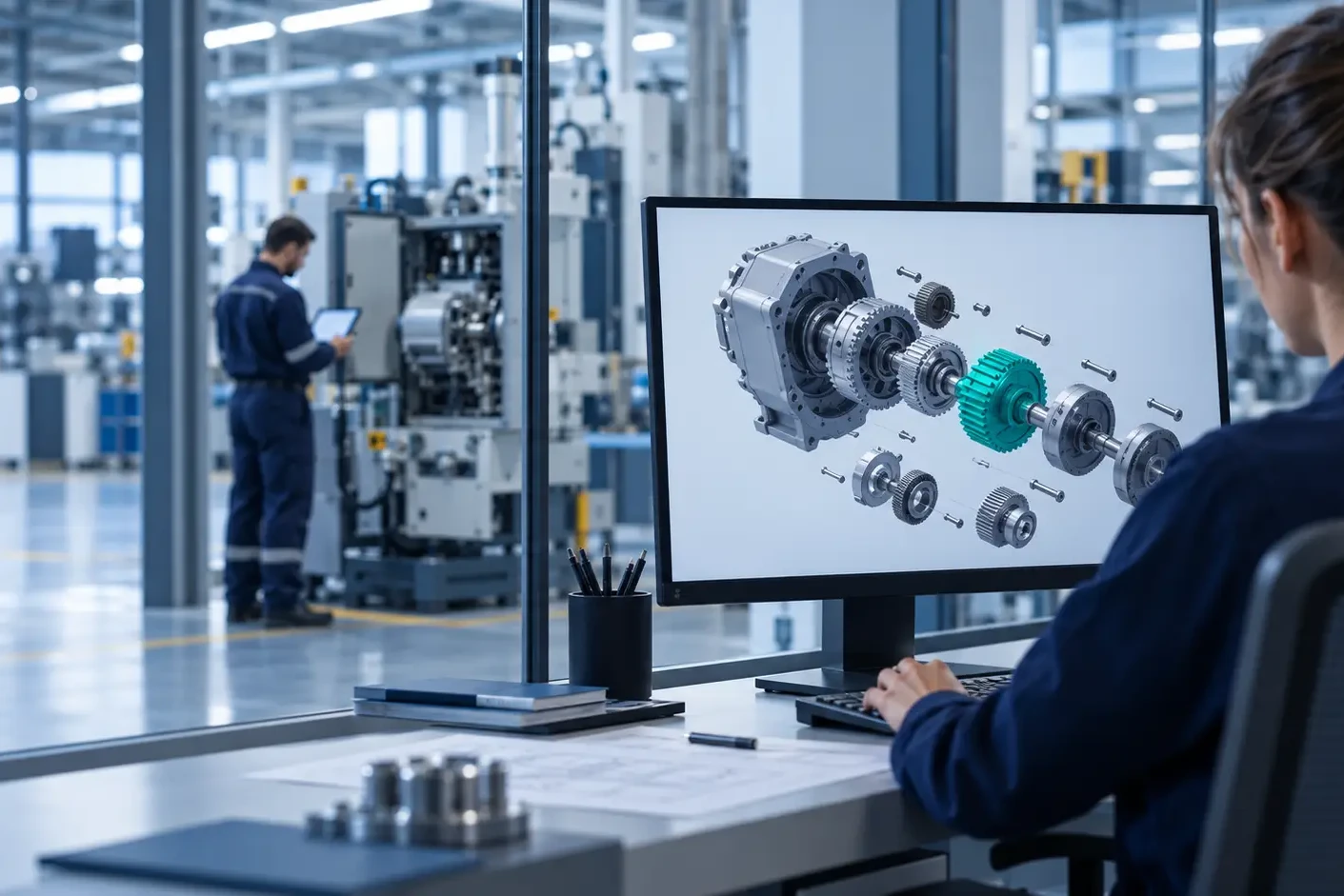


Thursday afternoon, an urgent order reaches the plant: four drive shafts for a customer whose line has stopped. The planner moves the job ahead of a series order, material is prepared and machining starts the next morning. Two days later, quality notices that the parts were built to revision B. Engineering released revision C three months ago, and that is the version the customer’s machine needs.
The parts are scrapped, the job is repeated and the series order is delayed again. The plant has paid twice for the same spare part.
Every spare part is a small production order
For a Manufacturing Director, spare parts orders are a constant source of disruption. They arrive in small quantities, often urgently, and they compete with series production for the same machines, materials and people. A wrong order is not only a commercial problem. It is lost capacity, wasted material and a less stable production plan.
Where wrong spare parts orders come from
Most wrong orders are created long before they reach the shop floor. They usually come from the same few places:
- A catalogue that still offers superseded parts, because it works on a copy of engineering data that is updated later.
- Part numbers typed again by hand when an email or a portal order is entered into the ERP.
- Descriptions instead of references, which someone has to interpret and check with engineering.
Each of these steps adds time, and each one is a chance to build the wrong revision. We looked at the wider cost of this disconnection in The hidden cost of disconnected Windchill PLM and ERP systems.
See the difference in practice: follow the same spare part order with and without ISFsoft Spare Portal.
Simulation · Spare part order
Follow one spare part order to the plant
Four drive shafts, ordered urgently for a stopped machine. Switch between the two scenarios to compare the journey.
Result of this order
Illustrative example based on common situations in manufacturing companies.
Four changes when spare parts orders come from ISFsoft Spare Portal
ISFsoft Spare Portal is synchronized directly with Windchill, so every order starts from the same product data the plant uses. For production, this creates four changes.
1. The same data as production
Spare parts orders are based on the same product structure and revisions released by engineering. What the plant builds for the aftermarket is consistent with what it builds for new machines.
2. No more producing obsolete parts
When a component is superseded, the portal stops offering the old version immediately. The plant avoids the wasted material, rework and scrap caused by orders for outdated references.
3. Orders that arrive ready to plan
Through ISFsoft Connect, orders flow automatically into the ERP with the correct part numbers and quantities. Production planning receives clean demand instead of manual requests that need to be checked and corrected.
4. Fewer urgent interruptions
Wrong orders are the main cause of emergency rework. When customers order the right part the first time, spare parts can be scheduled alongside series production rather than interrupting it.
What the plant gains
- A more stable production plan, with fewer last-minute changes.
- Less scrap and rework caused by outdated references.
- An aftermarket served efficiently, without sacrificing the performance of core operations.
The same precision that engineering puts into each released change now reaches every spare part the plant builds. If you want to see how this works from engineering’s side, read Engineer once, serve everywhere.
Every spare part is a small production order, and it deserves the same precision as the rest.
Want to see how ISFsoft Spare Portal would send cleaner orders to your plant? Get in touch with us and we will show you how it works with a real product structure.