


Windchill custom development vs independent software: a strategic choice for PTC partners
When “extension” becomes a risk
In the PTC ecosystem, terms like “extensions”, “add-ons”, “plugins”, “integrations” and “custom code” are often used as if they meant the same thing. For Windchill partners, that confusion is not harmless: it directly affects project scope, delivery expectations, and who carries the long-term responsibility once the system is live.
When customers ask for capabilities beyond standard Windchill functionality, many conversations jump straight to custom development. Sometimes that is the right answer. The problem is when it becomes the default, especially for needs that repeat across customers. That is how partners quietly accumulate technical debt, rising maintenance costs, and increasing delivery risk, often without pricing those commitments properly.
What “independent software” means in a Windchill context
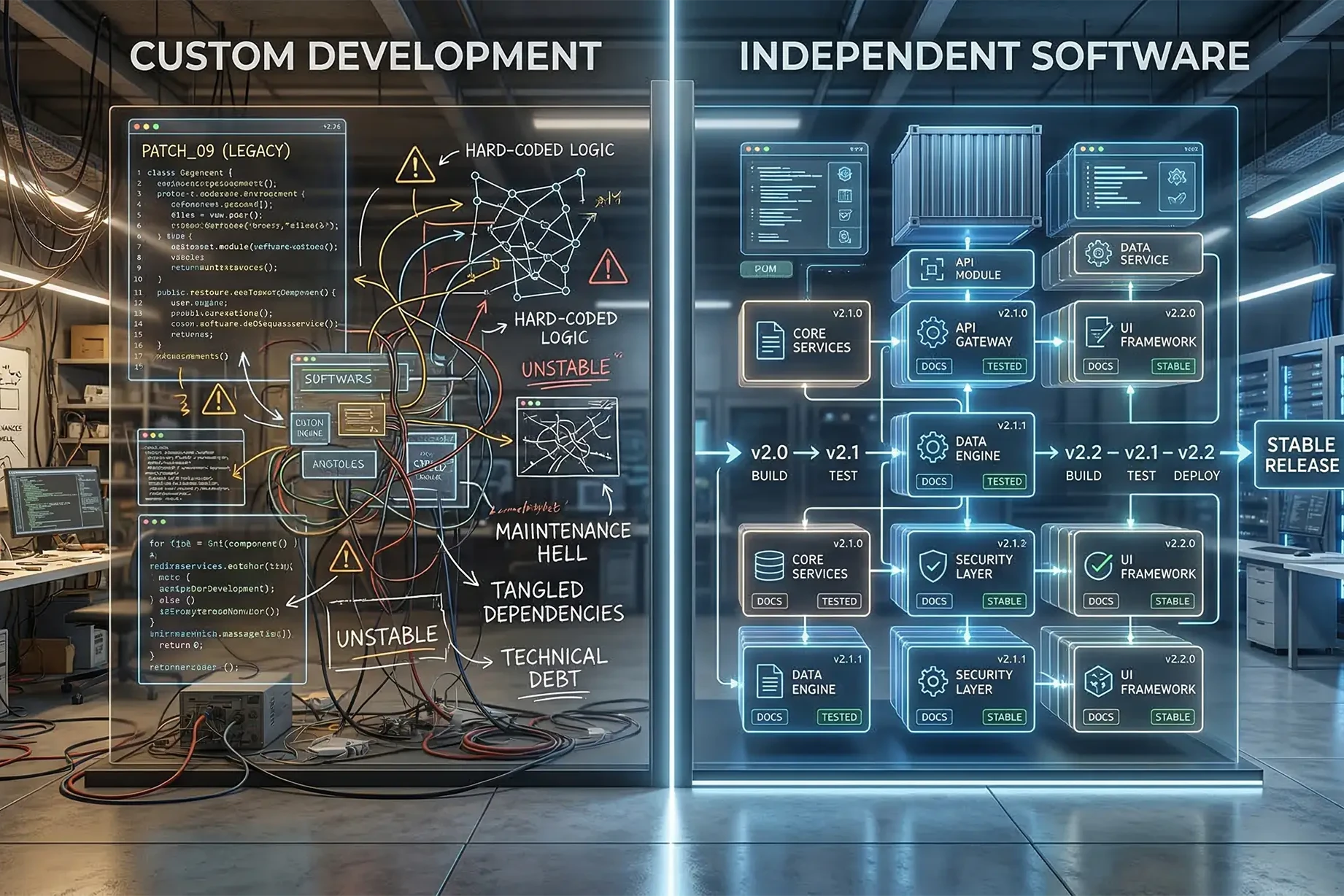
Independent software designed to work with Windchill is not “Windchill code”. It is a separate product with its own lifecycle, built to integrate with Windchill, leverage Windchill data, and extend functional coverage around the platform, while remaining a standalone solution.
That distinction matters because it changes the nature of the promise a partner makes. With productized software, the partner introduces a capability that is versioned, documented, supported, and improved through a vendor roadmap. With custom code, the partner often becomes the long-term owner of the solution’s evolution, compatibility, and stability.
In mature PLM environments, where similar requirements appear again and again, independent products can provide a scalable way to deliver outcomes without turning every request into a new permanent engineering obligation.
Why custom development becomes expensive after go-live
Custom work is attractive because it feels flexible and immediate. It can also generate short-term services revenue. The long-term cost, however, usually shows up after go-live: upgrades, regression testing, unexpected interactions with other systems, staff turnover, and the reality that “small” customizations are rarely small two years later.
The issue is not that custom development is bad. The issue is that recurring needs solved with repeated custom builds create complexity that does not scale. Over time, teams end up maintaining multiple variants of similar functionality across customers, which increases effort and erodes margins. In practice, partners pay for this with time, delivery capacity, and predictability.
The strategic difference: repeatability and controlled risk
The real advantage of independent software is not technical elegance; it is business scalability. PTC partners that grow profitably tend to build portfolios of repeatable offerings, using custom work selectively, only where it is truly unique.
Productized capabilities are easier to position, scope, and package. They reduce uncertainty in proposals, shorten delivery cycles, and lower the risk that a project becomes hostage to a bespoke codebase. They also make the partner’s model more resilient, because value scales through repeatability rather than through increasing complexity.
A partner decision, not just an engineering choice
Ultimately, the choice between independent software and custom development is a decision about what kind of partner business you want to build. If growth depends on one-off builds, the business scales with complexity and internal bottlenecks. If growth depends on repeatable capabilities around Windchill, the business scales with controlled risk and predictable delivery.
Custom development will always have a place. But treating it as the default for recurring requirements is rarely sustainable. In a competitive Windchill market, clarity on this point is not a technical nuance, it is a strategic advantage.
If you are a Windchill partner looking to expand your offering with repeatable, lower-risk capabilities, we’d be happy to talk about partnering >>

The hidden cost of disconnected Windchill PLM and ERP systems in manufacturing
Digital transformation in manufacturing often begins with the implementation of powerful platforms such as Windchill PLM and a robust ERP system. On paper, the technological landscape looks complete: engineering manages product structures and revisions in Windchill PLM, while operations, procurement and finance rely on ERP to plan and execute production.
However, in many industrial organizations these systems do not truly operate as one.
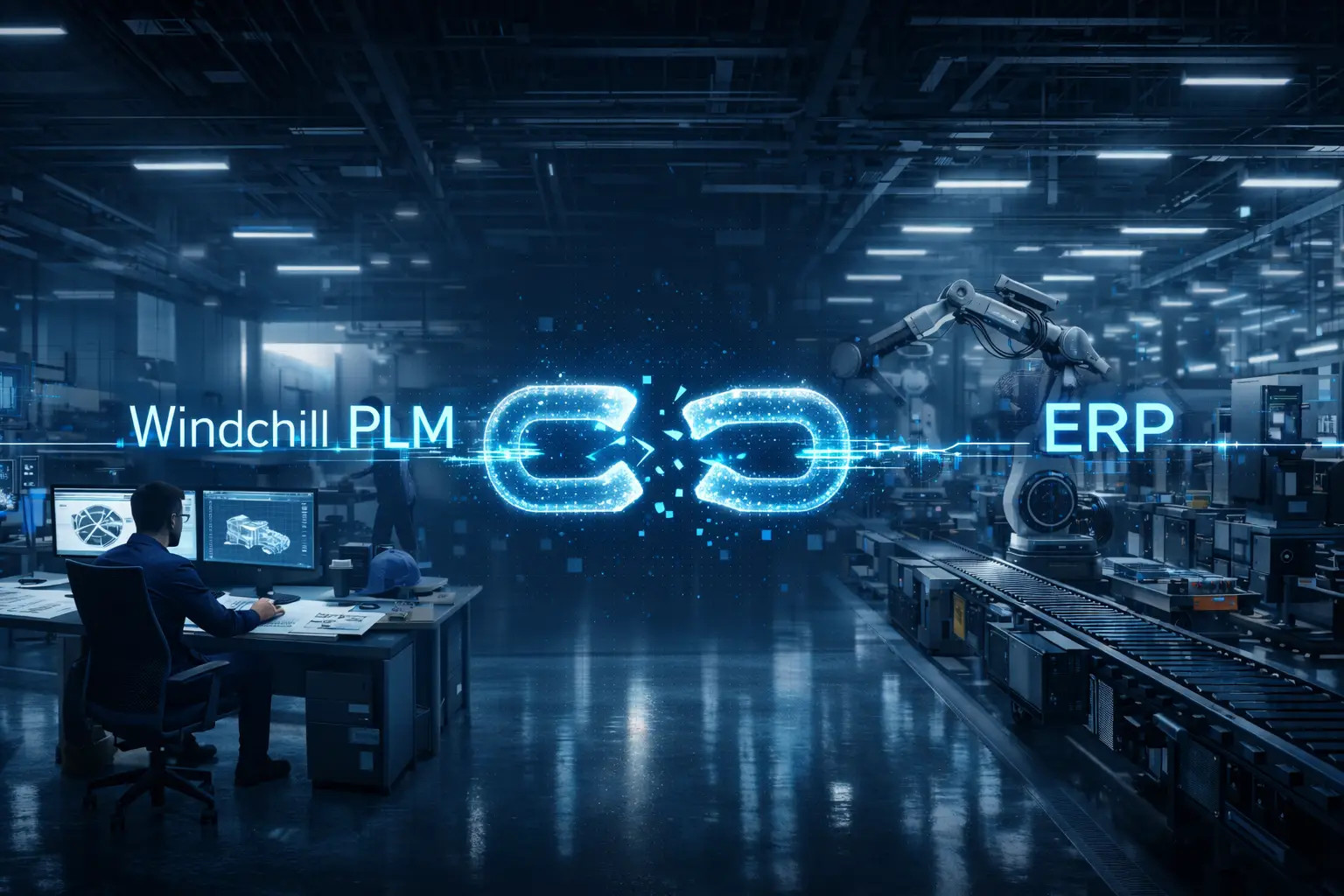
When Windchill PLM and ERP are not properly integrated, the gap between engineering and operations quickly becomes a structural weakness. What initially appears to be a technical limitation gradually turns into an operational problem that affects cost control, product quality and time-to-market.
The operational risk of disconnected systems
Modern product development is significantly more complex than it was just a decade ago. Companies design products that combine mechanical components, electronics and software while coordinating engineering teams, suppliers and manufacturing sites across multiple locations and time zones.
In this context, product information cannot remain isolated inside engineering tools.
When Windchill PLM operates independently from ERP, the organization begins to fragment. Engineering defines product structures and revisions in Windchill PLM that production may not immediately see reflected in ERP, while manufacturing teams update operational data that rarely flows back into engineering environments. Procurement and finance may therefore work with cost or planning data that does not fully match the latest design reality.
The result is not immediate chaos, but a gradual accumulation of inefficiencies. Manual exports, spreadsheet bridges, duplicated data entries and email confirmations become routine practices that compensate for the lack of system synchronization.
Over time, these workarounds create a fragile operational model that slows the organization down.
BOM inconsistencies: the most visible symptom
One of the areas most affected by the lack of integration between Windchill PLM and ERP is the Bill of Materials. The BOM represents the backbone of manufacturing operations, connecting engineering design with procurement, planning and production.
When BOM structures or revisions must be transferred manually between Windchill PLM and ERP, inconsistencies inevitably appear. A component revision may be outdated, a variant configuration may be incomplete, or a manufacturing process may not reflect the most recent engineering change.
These inconsistencies quickly move beyond the system and into the shop floor. Production errors increase, rework becomes more frequent and inventory levels grow unnecessarily because outdated or incorrect data drives operational decisions.
What initially appears to be a minor data synchronization issue can therefore translate into measurable financial impact and operational inefficiency.
Engineering changes without synchronization
Engineering Change Notices and Engineering Change Orders are essential for controlling product evolution. Windchill PLM provides the structure and traceability needed to manage these changes, but the benefits disappear if the changes are not automatically synchronized with ERP.
Without integration, production may continue manufacturing based on obsolete revisions while procurement orders components tied to previous versions of the product. Project schedules may also fail to reflect the real impact of engineering modifications.
In global manufacturing environments where production operates continuously, this lack of synchronization increases operational risk and complicates compliance and traceability requirements.
More importantly, it undermines confidence in enterprise data. When teams cannot fully trust the information available in their systems, decision-making slows down and additional validation steps become necessary before moving forward.
The hidden impact on time-to-market
Many organizations believe their time-to-market challenges come from product complexity or limited resources. In reality, the underlying problem is often data inconsistency between Windchill PLM and ERP.
Before launching a product, teams frequently spend significant time verifying that engineering data and manufacturing structures match across systems. They review BOM revisions, validate routing information and manually reconcile discrepancies that appear between platforms.
These activities do not contribute to innovation or product improvement. Instead, they compensate for disconnected systems.
When Windchill PLM and ERP are properly integrated, synchronization becomes automatic and the number of data errors decreases significantly. As a result, product launches move faster because teams can focus on engineering and manufacturing decisions instead of resolving system inconsistencies.
Integration as a strategic capability
Integrating Windchill PLM with ERP is not simply a technical improvement but a fundamental step toward operational coherence. When engineering, manufacturing and business systems are properly connected, product information flows consistently across the organization and teams can rely on a single source of truth.
This alignment allows companies to reduce errors, improve collaboration and accelerate decision-making while maintaining full traceability of product and manufacturing data.
In modern manufacturing environments where complexity continues to grow, the integration between Windchill PLM and ERP has become a critical capability rather than an optional improvement. Organizations that succeed in connecting these systems are not only improving their IT architecture; they are strengthening the foundation that supports their entire product lifecycle and operational performance.
This is precisely the role of ISFsoft Connect. Designed as an integration platform between Windchill PLM and ERP systems, ISFsoft Connect enables organizations to synchronize product data, engineering changes, manufacturing structures and operational information across systems in a controlled and traceable way. By creating a reliable bridge between engineering and operations, companies can eliminate manual data transfers, reduce inconsistencies and ensure that product information flows seamlessly across the entire organization.
Discover how ISFsoft Connect helps companies integrate Windchill PLM with ERP systems and build a truly connected manufacturing environment >>

How complementary software increases the value of Windchill projects for PTC partners
The structural ceiling many Windchill partners face
For many PTC partners working with Windchill, growth has traditionally been measured in new customers: more logos, more implementations, and more licenses. In a mature PLM market, however, the real limitation is often no longer acquisition, it is project value.
Windchill implementations are substantial engagements, yet the commercial structure is frequently predictable: platform scope, implementation services, configuration, training, and support. Once the system goes live, the relationship continues, but revenue growth tends to slow. The opportunity becomes incremental rather than strategic, and many partners encounter a ceiling that is structural, not temporary.
The question, increasingly, is not how to win more Windchill projects. It is how to increase value within each one.
Moving beyond core Windchill implementation
Windchill provides a powerful PLM backbone, but customers rarely view PLM as an isolated engineering system. They expect it to influence manufacturing, quality, sales, service, and aftermarket operations. As expectations expand, so does the potential scope of each Windchill project.
When a partner relies exclusively on core implementation, the commercial conversation remains centered on the platform itself. When a partner complements Windchill with additional, specialized software designed to work with it, the conversation shifts. The engagement evolves from a system deployment into a broader operational solution, and that shift has direct implications for revenue and margin.
Increasing average project value
Complementary software allows partners to address operational challenges that extend beyond standard Windchill functionality in a scalable way. Instead of positioning every additional requirement as custom development, partners can introduce productized capabilities that expand functional coverage without compromising the integrity of the core platform. The outcome is typically a broader proposal, clearer value framing, and higher overall project value.
In practical terms, this changes the dialogue from “implementing Windchill” to “maximizing the impact of Windchill across the business,” which is a fundamentally stronger commercial position.
Unlocking post-go-live expansion
Many Windchill projects follow a predictable lifecycle: analysis, implementation, stabilization, and then a quieter period where activity slows. Complementary software changes that dynamic because customer needs do not stop after go-live—if anything, they become more specific once the platform is in daily use.
As customers mature in their PLM journey, new needs naturally emerge: improved access to product data beyond engineering, enhanced visualization for broader teams, integration with downstream processes, and usability improvements that accelerate adoption. Each of these moments becomes an opportunity to expand the solution footprint and extend the engagement in a structured way.
This is where partners move from being implementers to becoming long-term solution architects, continuously evolving the customer’s Windchill environment.
Strengthening recurring service revenue
Every additional solution integrated into a Windchill landscape generates associated services: consulting, configuration, integration, optimization, training, and support. Partners retain full ownership of the customer relationship while expanding recurring service streams around a stable software foundation.
Just as important, this approach reduces dependency on custom development. Custom code can increase short-term billing, but it often introduces maintenance complexity, version compatibility risk, and delivery overhead that erodes margin over time. Independent, productized software designed to work with Windchill offers a more scalable and sustainable path, especially for partners focused on repeatability and long-term profitability.
From project volume to project value
In an ecosystem where multiple partners offer comparable Windchill expertise, portfolio strategy becomes a primary lever for differentiation and margin protection. Complementary software is not about replacing Windchill; it is about reinforcing it with targeted capabilities that expand project scope, unlock post-go-live growth, and strengthen recurring revenue.
Partners don’t need more customers. They need more value per customer.
Expanding your Windchill portfolio strategically
At ISFinnovation, we develop independent software products designed to work with Windchill, helping PTC partners expand project scope without increasing delivery risk. We work exclusively through partners.
If you are exploring how to increase the value of your Windchill projects and strengthen your PLM offering, we would welcome the conversation.