



The invisible bottleneck in Windchill environments: why engineering becomes the gatekeeper of data
Every manufacturing company that has invested in PTC Windchill knows the promise: a single source of truth for all engineering data. BOMs, CAD models, technical documentation, part revisions — all controlled, versioned, and reliable.
And yet, in most of these organizations, something quietly goes wrong. Not in the system itself, but around it.
The problem nobody talks about in PLM reviews
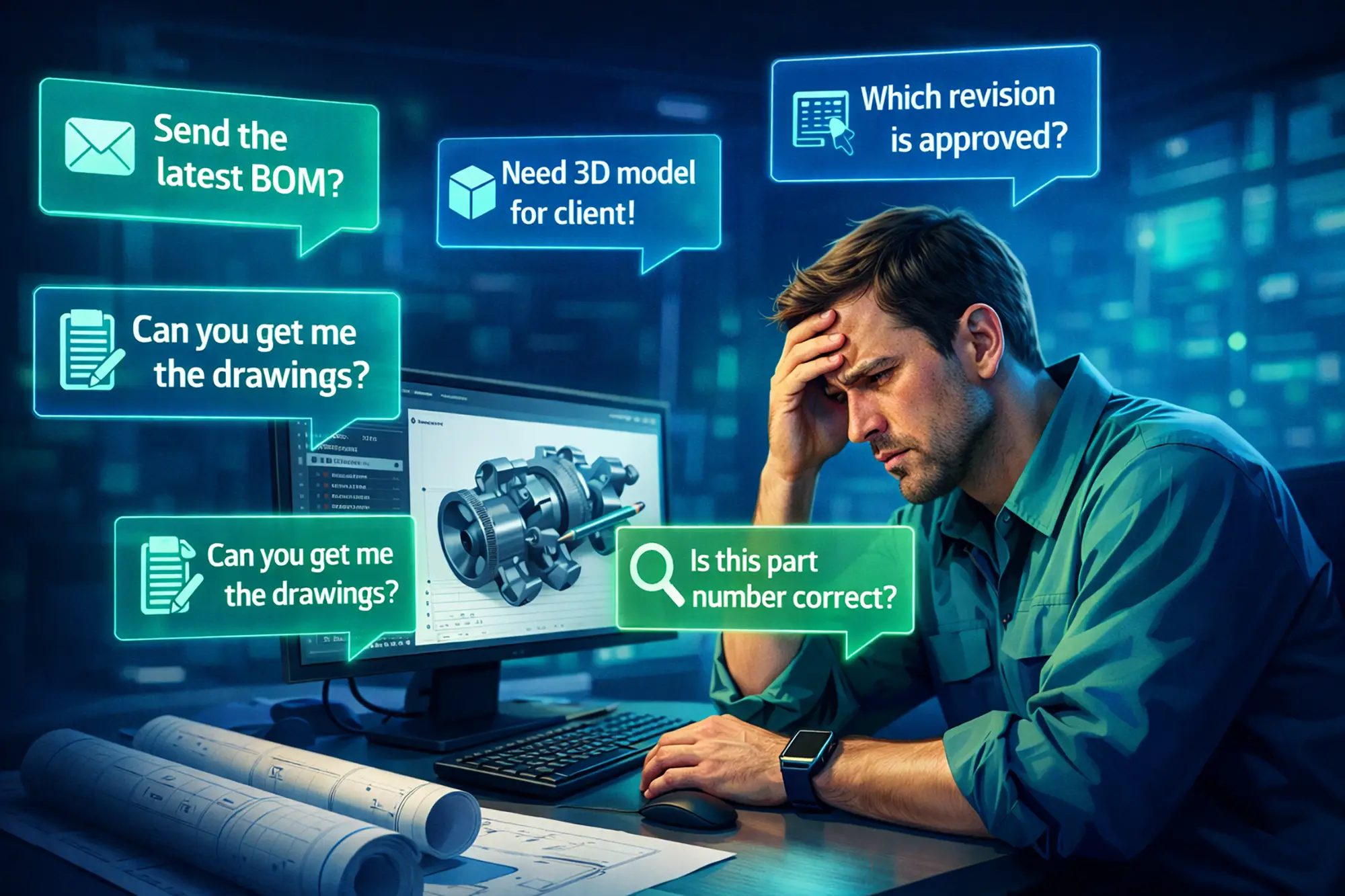
Ask any engineer in a Windchill-enabled company what their day looks like, and you will hear a version of the same story. Between design reviews, change requests, and validation tasks, there are the interruptions: a call from purchasing asking for the latest BOM of a component, an email from sales needing a 3D model for a customer presentation, a message from production asking whether drawing REV C or REV D is the one currently approved for manufacturing.
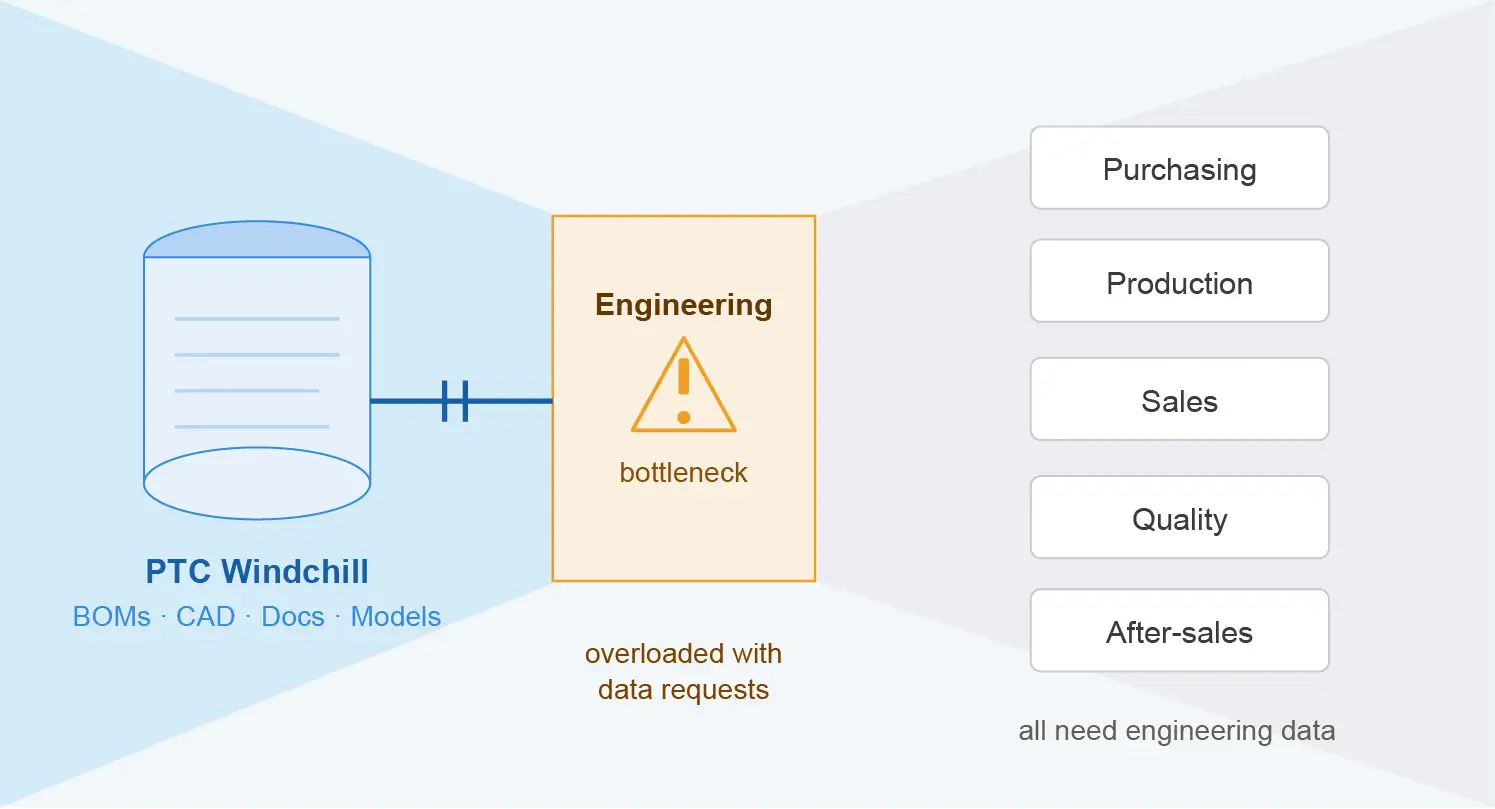
These requests are reasonable. The data exists. Windchill has it. But accessing it requires credentials, training, licenses, and a level of technical fluency that most people outside engineering simply do not have.
So the request lands on an engineer's desk. Then another one. Then ten more.
This is the invisible bottleneck and it is costing organizations far more than they realize.
When the system works, but the organization doesn't
Windchill is designed for engineering and PLM teams. Its data model, navigation logic, and permission structures reflect that. It is powerful precisely because it handles complexity: lifecycle states, variant configurations, associativity between CAD models and drawings, multi-level assemblies.
But that same sophistication creates a barrier for everyone else.
The procurement manager who needs to verify a part number. The after-sales technician looking for the exploded view of an assembly. The product manager preparing a roadmap presentation. The quality engineer in a supplier audit. None of them need the full power of Windchill. They need one specific piece of information, quickly, without a learning curve.
When that access doesn't exist, two things happen. First, those people stop trying to go to the source and start relying on informal channels — outdated PDFs saved on shared drives, screenshots shared on messaging platforms, verbal confirmations that may or may not reflect the current revision. Second, engineers absorb the demand, spending increasing portions of their workday as data intermediaries rather than doing the work they were hired to do.
The compounding costs of a data silo
The consequences are not just a matter of lost engineering hours, though that alone is significant. The downstream effects compound across the organization.
Part proliferation becomes a persistent problem when purchasing and production teams cannot easily search existing components before requesting new ones. Engineers approve variants that already exist in the system, simply because nobody checked.
Rework escalates when production or quality teams work from documentation that is not the latest approved revision. A drawing updated in Windchill two weeks ago may still be printed and laminated on the factory floor.
Decision-making slows down at every level. Product reviews, supplier negotiations, change impact assessments — all of them depend on people having access to reliable, current data. When that access requires submitting a request and waiting for an engineer to respond, velocity suffers.
Innovation stalls because the people responsible for it are busy answering data requests instead of solving engineering problems.
The root cause: access was designed for experts
This situation is not the result of poor PLM implementation. Most Windchill deployments are technically sound. The root cause is an assumption embedded in how enterprise PLM tools have traditionally been conceived: that the people who manage data are the same people who consume it.
In practice, that is never the case. The data lives in engineering, but the need for that data spreads across the entire organization and often beyond it, to suppliers, integrators, and service partners.
Designing access around expert users means that everyone else is excluded by default. And in organizations where data literacy and engineering expertise are not evenly distributed, which is every organization, exclusion becomes a structural bottleneck.
What democratizing access actually means
The phrase "data democratization" is used often enough to have lost some of its meaning. In the context of Windchill environments, it means something specific: giving every person in the organization the ability to find, view, and use the engineering data they need, without relying on an engineer to retrieve it for them.
This is not about opening up editing rights or removing governance. The integrity of Windchill data — its revision control, its lifecycle states, its approval workflows — must remain intact. What changes is the layer through which non-engineering users interact with it.
A read-only, intuitive, web-based interface that surfaces the right information in a form that any user can understand without PLM training is not a replacement for Windchill. It is an extension of it — one that absorbs the demand currently falling on engineering teams and redirects it to a self-service model.
What changes when the bottleneck is removed
When non-engineering teams can access data directly and independently, the shift is felt across the organization almost immediately.
Engineers reclaim time. Not in small increments, but in meaningful blocks that can be redirected toward the work that actually drives value: design, optimization, problem-solving.
Cross-functional teams move faster. Product development cycles that previously required multiple handoffs to retrieve information become more fluid. Departments that were data consumers become data-empowered.
Decision quality improves. When the product manager, the sales engineer, and the procurement lead are all looking at the same current, approved data, not a copy, not a screenshot, not a memory, the risk of decisions being made on outdated or incorrect information is substantially reduced.
And the cultural dynamic shifts as well. Engineering stops being the department that others are waiting on for basic information, and starts being the department that others trust as the source of truth, because access to that truth is no longer a bottleneck.
ISFsoft Viewer: built for this specific problem
ISFsoft Viewer was developed precisely to address this gap. It provides a web-based interface that connects to PTC Windchill and makes engineering data accessible to any user in the organization, without requiring Windchill licenses, without PLM training, and without involving engineering teams in the retrieval process.
Users can search by part number or name, browse structures, visualize 2D drawings and 3D models with zoom and rotation, download approved documentation, and access metadata, all from a clean, intuitive interface that works in any browser, on any device, 24 hours a day.
Access is controlled through role-based permissions, so each user sees exactly what they are authorized to see. The data always reflects what is current and approved in Windchill. There are no copies, no synchronization delays, no risk of working from an outdated version.
Equally important, ISFsoft Viewer is designed to be accessible from a cost perspective. Unlike solutions that charge per user, it operates on a server license model, meaning the entire organization can benefit from it without the licensing costs scaling with headcount. Broad adoption, which is precisely the point, does not come with a proportionally large bill.
For organizations running Windchill, it is not a replacement or a workaround. It is the access layer that was always missing.
Want to see how ISFsoft Viewer works in a real Windchill environment? Request a demo and explore what your teams could access today.


Why is access to information the biggest bottleneck in engineering?
The hidden costs of isolated engineering information
When engineering data is not accessible to the entire organization, the negative effects become immediately evident. Engineering teams turn into bottlenecks, constantly interrupted by information requests from other departments. This not only diverts their attention from essential innovation and development tasks but also creates a fragmented and inefficient workflow. The time lost responding to emails, attending calls, or generating specific content for other teams directly impacts the company’s productivity and agility.
The weaknesses of inaccessible engineering information
- Data duplication: Lack of access to updated information leads to the unnecessary creation of documents and files, resulting in redundancies and wasted resources.
- Proliferation of parts: Without a centralized view, different departments may generate similar or duplicate parts, hindering standardization and increasing operational complexity.
- Rework costs: Lack of access to reliable information leads to avoidable errors, requiring tasks to be redone, draining time and budget.
- Slowed innovation: Limited information flow between teams reduces the speed at which products can be developed and improved.
- Poor collaboration: Without a shared database, teams work with outdated or partial information, leading to poor decisions and missed opportunities.
- Longer development time: Fragmented information causes delays in design and manufacturing cycles, affecting the company’s competitiveness.
- Delayed time-to-market: Difficulty in accessing and sharing data affects responsiveness to market changes and opportunities, potentially leading to a loss of competitive advantage.
Inefficiency, overhead costs, and delays: The Price of Isolated Information
The lack of accessibility to engineering data has tangible consequences that directly impact operational efficiency and profitability:
- Lower productivity: Time spent searching for or requesting information translates to fewer hours dedicated to innovation and product development.
- Additional costs: Duplicated efforts and rework increase operating expenses.
- Innovation delays: Inefficient information flows extend development cycles.
- Higher error margin: The absence of a single, reliable source of information increases the risk of inconsistencies and product failures.
Data democratization: The key to optimizing processes and enhancing collaboration
To overcome these challenges, companies must invest in controlled and secure access to engineering information. This transformation of internal processes helps correct the previously mentioned weaknesses:
- Optimized resources and efficiency: Eliminating data duplication and facilitating access to accurate information allows teams to work more efficiently, reducing administrative time and maximizing productivity.
- Faster innovation and development: A smooth and transparent data flow enables better collaboration between departments, driving creativity and continuous improvement in design and production processes.
- Improved decision-making: Access to key information ensures that different departments work in alignment with up-to-date and reliable data, reducing errors and response times.
The solution: ISFsoft Viewer – Simplified Access and visualization of engineering data
To address the inefficiencies caused by limited access to engineering data, we have developed ISFsoft Viewer, an innovative solution that provides seamless access and visualization of critical Windchill information on a single, intuitive platform.
With ISFsoft Viewer, teams can:
- Quickly search for and access the information they need, without barriers or dependencies on other departments.
- Reduce time spent on administrative tasks, allowing engineers to focus on innovation and development.
- Enhance collaboration and decision-making by providing real-time, precise, and easily accessible data.
Eliminating barriers to engineering information access not only optimizes internal processes but also drives efficiency and innovation. With ISFsoft Viewer, companies can transform their data management approach, enabling each team to focus on what truly matters: developing high-quality products and achieving operational excellence.