



Why your sales team shouldn't depend on engineering to make a quote
The scene you know too well
It's Tuesday afternoon. A promising lead has asked for a quote on a customized machine. Your sales rep pulls together the commercial details — pricing, delivery terms, margin — but before anything can go out, they need engineering to validate the configuration.
Engineering is already deep in three active projects. They'll get to it by Thursday. Maybe Friday.
The customer follows up on Wednesday. The sales rep says "we're working on it." On Friday the quote goes out. By Monday, the customer has signed with a competitor who replied on Wednesday.
Sound familiar? For most industrial manufacturers — especially those working in Engineer-to-Order (ETO) or Configure-to-Order (CTO) environments, this isn't an edge case. It's the default.
Why this happens: the knowledge problem
The core issue isn't speed or workload. It's where product knowledge lives.
In most manufacturing companies, the rules that govern how a product can be configured — which components are compatible, what's technically feasible, how a change in one module affects another — exist exclusively inside the heads of engineers and in the structure of your PLM system.
Sales teams don't have access to that knowledge in any usable form. So every time a customer asks for something even slightly customized, the commercial process hits a wall and waits for the technical team to climb over it.
This creates a structural dependency that's slow by design. Not because your engineers are slow — they're not — but because they're being used as a lookup service for information that shouldn't require their expertise to retrieve.
The real cost: further than you think
The obvious cost is the delayed quote. But the downstream effects are harder to measure and far more damaging.
Lost deals you never see. Many customers don't tell you they went elsewhere. They simply go quiet. You follow up, they politely say they went in a different direction. You never know that a 48-hour delay was the reason.
Engineering time destroyed. Every interruption to validate a configuration or check feasibility for a quote that may never close pulls an engineer out of design work. Studies on context-switching in technical roles consistently show that a five-minute interruption can cost 20 minutes of productive work. Multiply that across a week and you're looking at significant capacity loss.
An unreliable customer experience. Today's industrial buyers have rising expectations about responsiveness. If your process feels slow and opaque compared to what they experience in their personal lives or with more agile competitors, it erodes trust before the relationship even begins.
A sales team that feels powerless. Experienced sales reps know this pain well. Over time, it changes how they work: they stop pursuing edge cases, they self-censor ambitious customizations, they promise less to avoid the engineering bottleneck. The commercial potential of your product portfolio shrinks, quietly, from the inside.
This is worth reading carefully if your sales cycle for complex products regularly exceeds a week. The bottleneck described here is solvable and solving it doesn't require hiring more engineers.
It's not a people problem
Before going further, it's worth being explicit about something: the friction described above is not caused by engineers being uncooperative, or sales being impatient.
It's a process and tooling problem.
The current workflow asks the wrong people to do the wrong jobs. It uses your highest-cost technical resources to answer questions that — with the right system — shouldn't require human judgment at all. And it leaves your commercial team without the autonomy they need to compete effectively.
Reframing it this way matters because the solution isn't cultural (telling engineering to be faster) or organizational (hiring more engineers). It's structural: give the right people access to the right product knowledge, at the right moment in the process.
What CPQ means in a complex manufacturing context
CPQ stands for Configure, Price, Quote. In consumer contexts it often refers to simple product builders. In industrial manufacturing, particularly ETO and CTO environments, it means something considerably more demanding.
A CPQ solution for complex manufacturing needs to:
- Encode the full logic of your product variants, constraints, and dependencies
- Allow a non-technical user to configure a valid, technically feasible product
- Automatically generate an accurate price based on the selected configuration
- Produce a quotation document that can go straight to the customer
- Optionally, trigger downstream outputs like eBOMs, 3D drawings, or production documentation
The key word in that list is valid. The system must prevent invalid configurations from being created in the first place — not flag them after the fact. That's the difference between a tool that creates work and one that eliminates it.
For companies running their product data in PTC Windchill, this presents a specific challenge: the CPQ solution needs to integrate natively with the Windchill environment, drawing on the product structures, part libraries, and variant logic already defined there — not replicate or duplicate them.
What changes when sales can configure independently
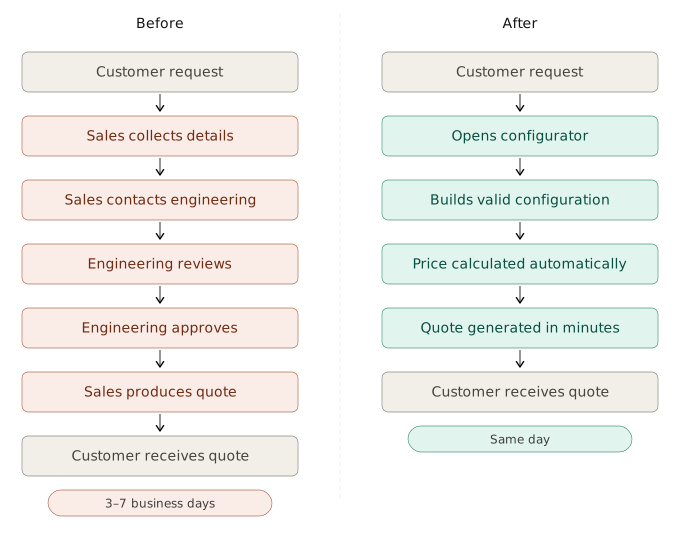
Here's the before/after at a workflow level:
Before: Customer request → Sales collects details → Sales contacts engineering → Engineering reviews and validates → Engineering approves or suggests changes → Sales produces quote → Customer receives quote. Typical elapsed time: 3–7 business days.
After: Customer request → Sales opens configurator → Sales builds valid configuration using guided logic → Price is calculated automatically → Quote is generated in minutes → Customer receives quote. Typical elapsed time: same day.
Engineering is not removed from the process. They define the configuration logic upfront — the rules, constraints, and pricing models. That's one-time, high-value work. What they're freed from is being consulted on every individual quote
ISFsoft Sales Configurator is built specifically for this workflow: a CPQ solution designed for PTC Windchill environments, with native support for ETO and CTO processes. It allows sales teams to independently generate complete, technically valid quotes for complex customized products — without opening a support ticket with engineering.
What to look for in a CPQ for ETO/CTO environments
If you're evaluating CPQ options for a complex manufacturing context, these are the criteria that separate a useful solution from one that creates more problems than it solves:
Native PLM integration. The configurator should read product logic from your existing PLM — not require you to maintain a parallel dataset. In a Windchill environment, this means bi-directional integration, not just an export.
Constraint-based configuration. Rules that prevent invalid combinations must be enforced at the point of selection, not surfaced as errors after the fact.
Automatic eBOM and drawing generation. For the quote to be more than a commercial document, it should trigger the technical outputs engineering needs: structured BOM, updated CAD drawings, production-ready documentation.
Role-appropriate interface. Sales users shouldn't need to understand product architecture. The interface should guide, constrain, and present options in commercial terms.
Scalability across product complexity. Solutions that work for 10 variants often break at 1,000. Verify it against your actual product catalog, including your most complex configurations.
The deeper shift: from gatekeeping to enabling
The most durable benefit of giving sales teams configurator autonomy isn't the faster quote. It's the change in how your organization relates to its own product knowledge.
When configuration logic is encoded in a system — rather than locked in engineering heads — it becomes shareable, scalable, and consistent. A new sales hire can quote as accurately as a 10-year veteran on day one. A partner or distributor can configure products without calling your office. The commercial surface of your company expands without proportional headcount growth.
That's not a small thing in an industry where product complexity tends to grow faster than the teams managing it.
See it in action
ISFsoft Sales Configurator is designed for manufacturers running PTC Windchill who want to close the gap between sales and engineering — without losing technical accuracy or forcing expensive customization.
Explore ISFsoft Sales Configurator →
Or if you'd like to see how it handles your specific product configuration challenges:
Talk to our team →
ISFsoft is developed by ISF Innovation Experts, an official PTC technology partner. The ISFsoft suite extends PTC Windchill with purpose-built solutions for visualization, integration, spare parts management, and product configuration.


The invisible bottleneck in Windchill environments: why engineering becomes the gatekeeper of data
Every manufacturing company that has invested in PTC Windchill knows the promise: a single source of truth for all engineering data. BOMs, CAD models, technical documentation, part revisions — all controlled, versioned, and reliable.
And yet, in most of these organizations, something quietly goes wrong. Not in the system itself, but around it.
The problem nobody talks about in PLM reviews
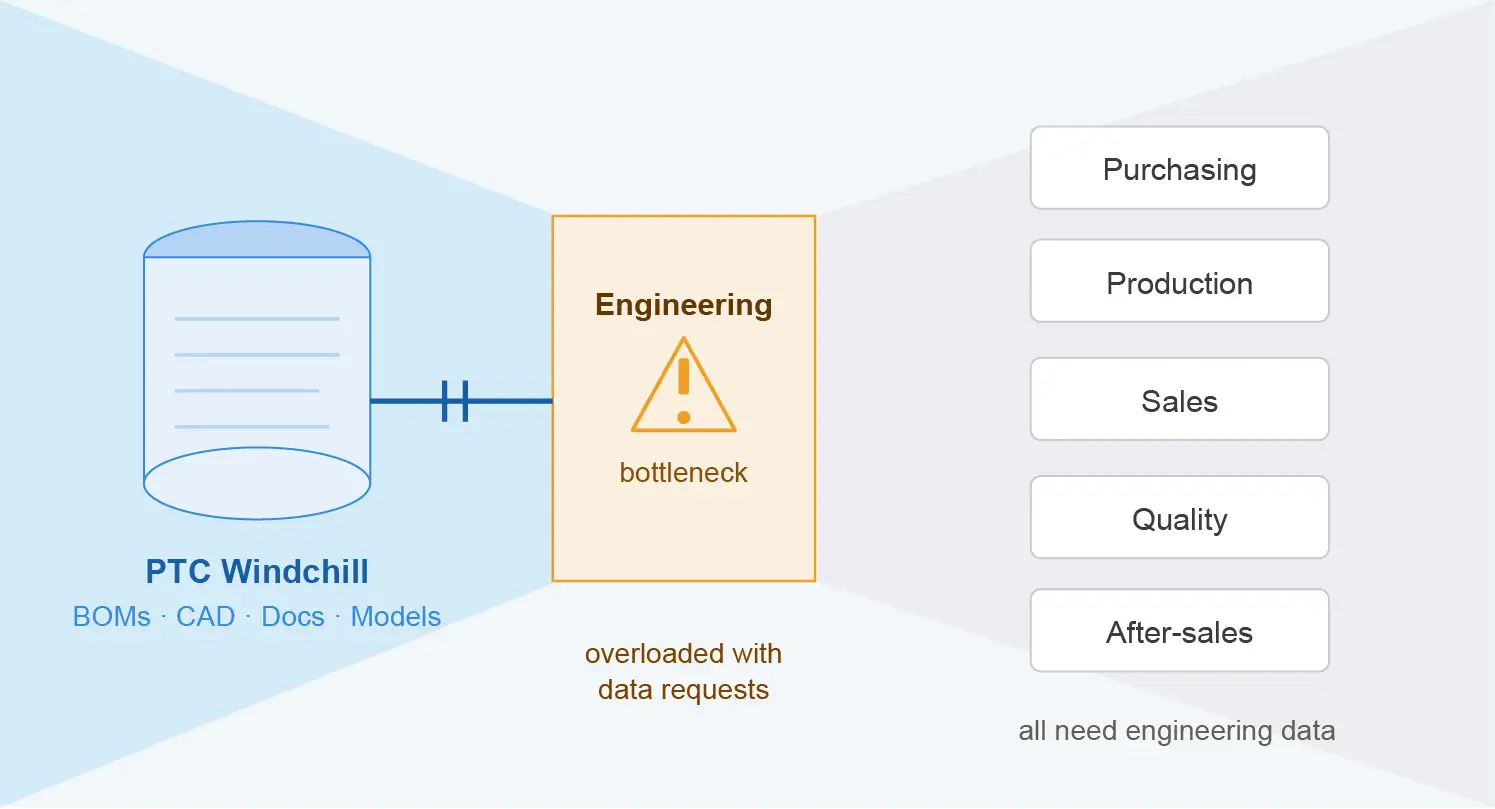
Ask any engineer in a Windchill-enabled company what their day looks like, and you will hear a version of the same story. Between design reviews, change requests, and validation tasks, there are the interruptions: a call from purchasing asking for the latest BOM of a component, an email from sales needing a 3D model for a customer presentation, a message from production asking whether drawing REV C or REV D is the one currently approved for manufacturing.
These requests are reasonable. The data exists. Windchill has it. But accessing it requires credentials, training, licenses, and a level of technical fluency that most people outside engineering simply do not have.
So the request lands on an engineer's desk. Then another one. Then ten more.
This is the invisible bottleneck and it is costing organizations far more than they realize.
When the system works, but the organization doesn't
Windchill is designed for engineering and PLM teams. Its data model, navigation logic, and permission structures reflect that. It is powerful precisely because it handles complexity: lifecycle states, variant configurations, associativity between CAD models and drawings, multi-level assemblies.
But that same sophistication creates a barrier for everyone else.
The procurement manager who needs to verify a part number. The after-sales technician looking for the exploded view of an assembly. The product manager preparing a roadmap presentation. The quality engineer in a supplier audit. None of them need the full power of Windchill. They need one specific piece of information, quickly, without a learning curve.
When that access doesn't exist, two things happen. First, those people stop trying to go to the source and start relying on informal channels — outdated PDFs saved on shared drives, screenshots shared on messaging platforms, verbal confirmations that may or may not reflect the current revision. Second, engineers absorb the demand, spending increasing portions of their workday as data intermediaries rather than doing the work they were hired to do.
The compounding costs of a data silo
The consequences are not just a matter of lost engineering hours, though that alone is significant. The downstream effects compound across the organization.
Part proliferation becomes a persistent problem when purchasing and production teams cannot easily search existing components before requesting new ones. Engineers approve variants that already exist in the system, simply because nobody checked.
Rework escalates when production or quality teams work from documentation that is not the latest approved revision. A drawing updated in Windchill two weeks ago may still be printed and laminated on the factory floor.
Decision-making slows down at every level. Product reviews, supplier negotiations, change impact assessments — all of them depend on people having access to reliable, current data. When that access requires submitting a request and waiting for an engineer to respond, velocity suffers.
Innovation stalls because the people responsible for it are busy answering data requests instead of solving engineering problems.
The root cause: access was designed for experts
This situation is not the result of poor PLM implementation. Most Windchill deployments are technically sound. The root cause is an assumption embedded in how enterprise PLM tools have traditionally been conceived: that the people who manage data are the same people who consume it.
In practice, that is never the case. The data lives in engineering, but the need for that data spreads across the entire organization and often beyond it, to suppliers, integrators, and service partners.
Designing access around expert users means that everyone else is excluded by default. And in organizations where data literacy and engineering expertise are not evenly distributed, which is every organization, exclusion becomes a structural bottleneck.
What democratizing access actually means
The phrase "data democratization" is used often enough to have lost some of its meaning. In the context of Windchill environments, it means something specific: giving every person in the organization the ability to find, view, and use the engineering data they need, without relying on an engineer to retrieve it for them.
This is not about opening up editing rights or removing governance. The integrity of Windchill data — its revision control, its lifecycle states, its approval workflows — must remain intact. What changes is the layer through which non-engineering users interact with it.
A read-only, intuitive, web-based interface that surfaces the right information in a form that any user can understand without PLM training is not a replacement for Windchill. It is an extension of it — one that absorbs the demand currently falling on engineering teams and redirects it to a self-service model.
What changes when the bottleneck is removed
When non-engineering teams can access data directly and independently, the shift is felt across the organization almost immediately.
Engineers reclaim time. Not in small increments, but in meaningful blocks that can be redirected toward the work that actually drives value: design, optimization, problem-solving.
Cross-functional teams move faster. Product development cycles that previously required multiple handoffs to retrieve information become more fluid. Departments that were data consumers become data-empowered.
Decision quality improves. When the product manager, the sales engineer, and the procurement lead are all looking at the same current, approved data, not a copy, not a screenshot, not a memory, the risk of decisions being made on outdated or incorrect information is substantially reduced.
And the cultural dynamic shifts as well. Engineering stops being the department that others are waiting on for basic information, and starts being the department that others trust as the source of truth, because access to that truth is no longer a bottleneck.
ISFsoft Viewer: built for this specific problem
ISFsoft Viewer was developed precisely to address this gap. It provides a web-based interface that connects to PTC Windchill and makes engineering data accessible to any user in the organization, without requiring Windchill licenses, without PLM training, and without involving engineering teams in the retrieval process.
Users can search by part number or name, browse structures, visualize 2D drawings and 3D models with zoom and rotation, download approved documentation, and access metadata, all from a clean, intuitive interface that works in any browser, on any device, 24 hours a day.
Access is controlled through role-based permissions, so each user sees exactly what they are authorized to see. The data always reflects what is current and approved in Windchill. There are no copies, no synchronization delays, no risk of working from an outdated version.
Equally important, ISFsoft Viewer is designed to be accessible from a cost perspective. Unlike solutions that charge per user, it operates on a server license model, meaning the entire organization can benefit from it without the licensing costs scaling with headcount. Broad adoption, which is precisely the point, does not come with a proportionally large bill.
For organizations running Windchill, it is not a replacement or a workaround. It is the access layer that was always missing.