



Why your sales team shouldn't depend on engineering to make a quote
The scene you know too well
It's Tuesday afternoon. A promising lead has asked for a quote on a customized machine. Your sales rep pulls together the commercial details — pricing, delivery terms, margin — but before anything can go out, they need engineering to validate the configuration.
Engineering is already deep in three active projects. They'll get to it by Thursday. Maybe Friday.
The customer follows up on Wednesday. The sales rep says "we're working on it." On Friday the quote goes out. By Monday, the customer has signed with a competitor who replied on Wednesday.
Sound familiar? For most industrial manufacturers — especially those working in Engineer-to-Order (ETO) or Configure-to-Order (CTO) environments, this isn't an edge case. It's the default.
Why this happens: the knowledge problem
The core issue isn't speed or workload. It's where product knowledge lives.
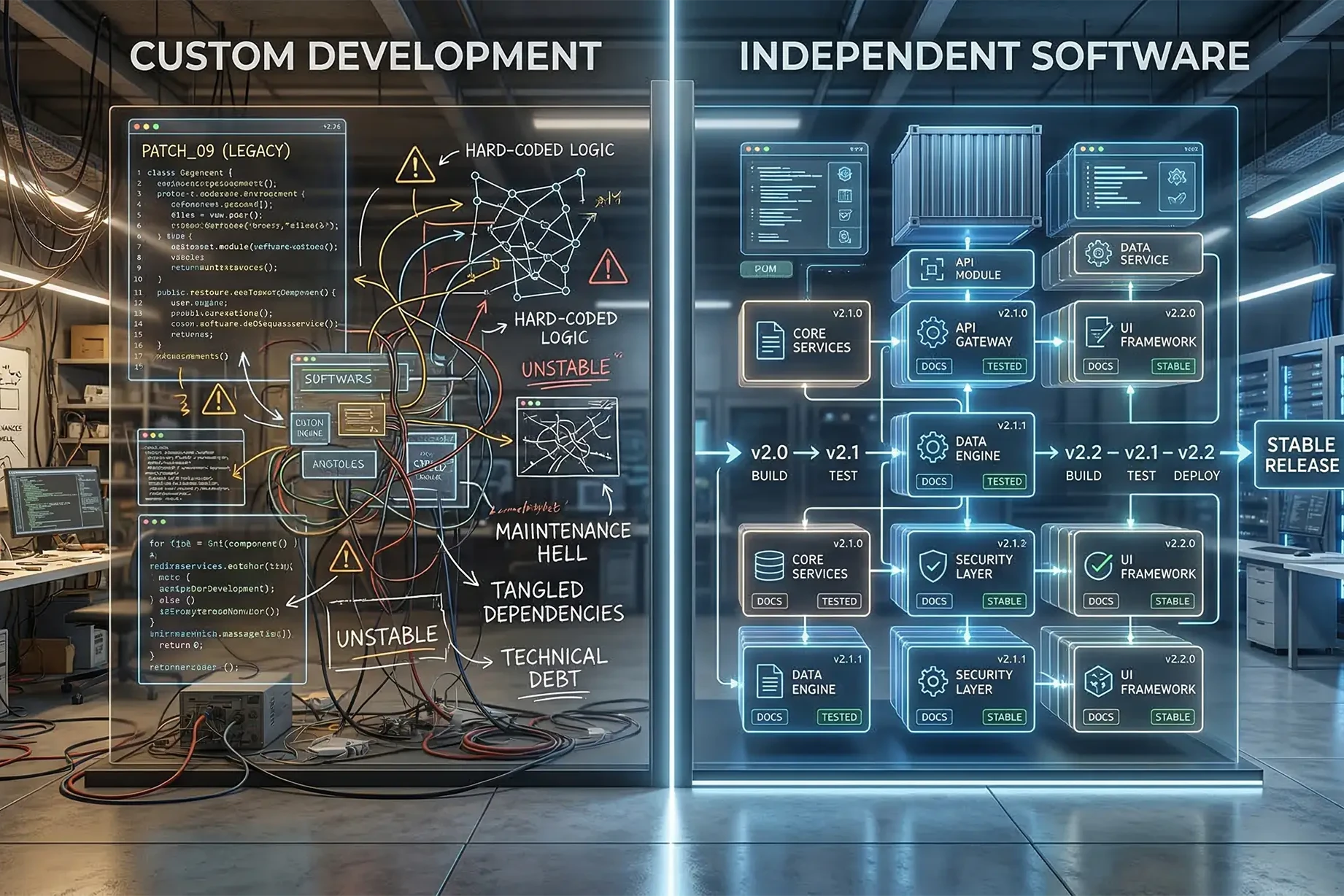
In most manufacturing companies, the rules that govern how a product can be configured — which components are compatible, what's technically feasible, how a change in one module affects another — exist exclusively inside the heads of engineers and in the structure of your PLM system.
Sales teams don't have access to that knowledge in any usable form. So every time a customer asks for something even slightly customized, the commercial process hits a wall and waits for the technical team to climb over it.
This creates a structural dependency that's slow by design. Not because your engineers are slow — they're not — but because they're being used as a lookup service for information that shouldn't require their expertise to retrieve.
The real cost: further than you think
The obvious cost is the delayed quote. But the downstream effects are harder to measure and far more damaging.
Lost deals you never see. Many customers don't tell you they went elsewhere. They simply go quiet. You follow up, they politely say they went in a different direction. You never know that a 48-hour delay was the reason.
Engineering time destroyed. Every interruption to validate a configuration or check feasibility for a quote that may never close pulls an engineer out of design work. Studies on context-switching in technical roles consistently show that a five-minute interruption can cost 20 minutes of productive work. Multiply that across a week and you're looking at significant capacity loss.
An unreliable customer experience. Today's industrial buyers have rising expectations about responsiveness. If your process feels slow and opaque compared to what they experience in their personal lives or with more agile competitors, it erodes trust before the relationship even begins.
A sales team that feels powerless. Experienced sales reps know this pain well. Over time, it changes how they work: they stop pursuing edge cases, they self-censor ambitious customizations, they promise less to avoid the engineering bottleneck. The commercial potential of your product portfolio shrinks, quietly, from the inside.
This is worth reading carefully if your sales cycle for complex products regularly exceeds a week. The bottleneck described here is solvable and solving it doesn't require hiring more engineers.
It's not a people problem
Before going further, it's worth being explicit about something: the friction described above is not caused by engineers being uncooperative, or sales being impatient.
It's a process and tooling problem.
The current workflow asks the wrong people to do the wrong jobs. It uses your highest-cost technical resources to answer questions that — with the right system — shouldn't require human judgment at all. And it leaves your commercial team without the autonomy they need to compete effectively.
Reframing it this way matters because the solution isn't cultural (telling engineering to be faster) or organizational (hiring more engineers). It's structural: give the right people access to the right product knowledge, at the right moment in the process.
What CPQ means in a complex manufacturing context
CPQ stands for Configure, Price, Quote. In consumer contexts it often refers to simple product builders. In industrial manufacturing, particularly ETO and CTO environments, it means something considerably more demanding.
A CPQ solution for complex manufacturing needs to:
- Encode the full logic of your product variants, constraints, and dependencies
- Allow a non-technical user to configure a valid, technically feasible product
- Automatically generate an accurate price based on the selected configuration
- Produce a quotation document that can go straight to the customer
- Optionally, trigger downstream outputs like eBOMs, 3D drawings, or production documentation
The key word in that list is valid. The system must prevent invalid configurations from being created in the first place — not flag them after the fact. That's the difference between a tool that creates work and one that eliminates it.
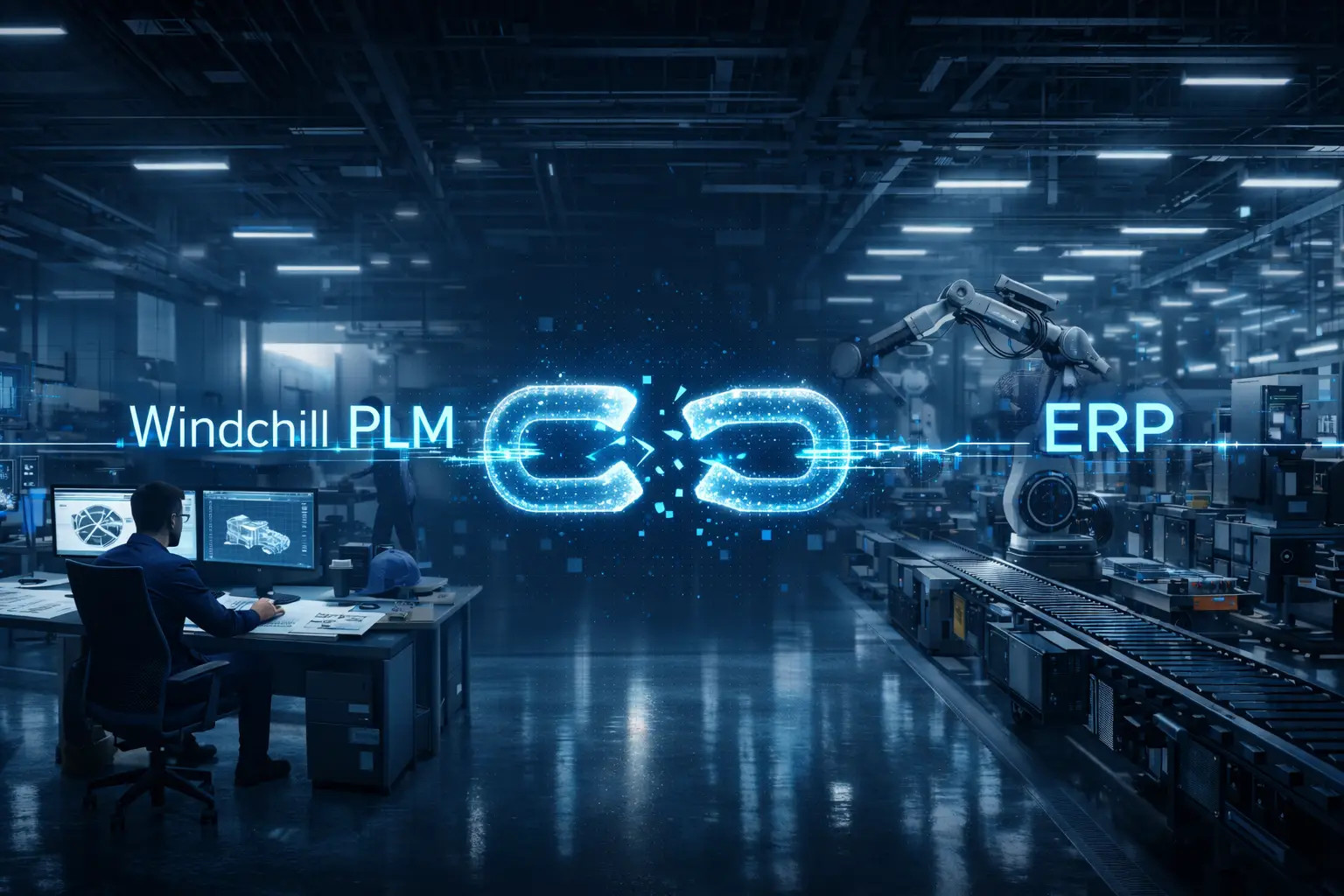
For companies running their product data in PTC Windchill, this presents a specific challenge: the CPQ solution needs to integrate natively with the Windchill environment, drawing on the product structures, part libraries, and variant logic already defined there — not replicate or duplicate them.
What changes when sales can configure independently
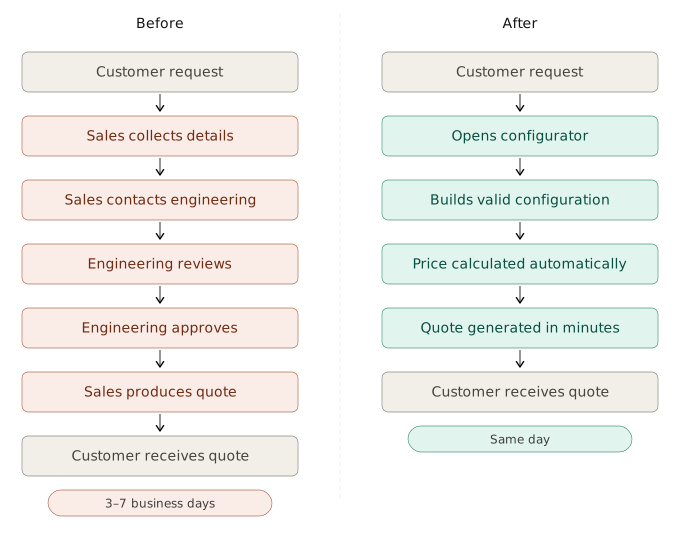
Here's the before/after at a workflow level:
Before: Customer request → Sales collects details → Sales contacts engineering → Engineering reviews and validates → Engineering approves or suggests changes → Sales produces quote → Customer receives quote. Typical elapsed time: 3–7 business days.
After: Customer request → Sales opens configurator → Sales builds valid configuration using guided logic → Price is calculated automatically → Quote is generated in minutes → Customer receives quote. Typical elapsed time: same day.
Engineering is not removed from the process. They define the configuration logic upfront — the rules, constraints, and pricing models. That's one-time, high-value work. What they're freed from is being consulted on every individual quote
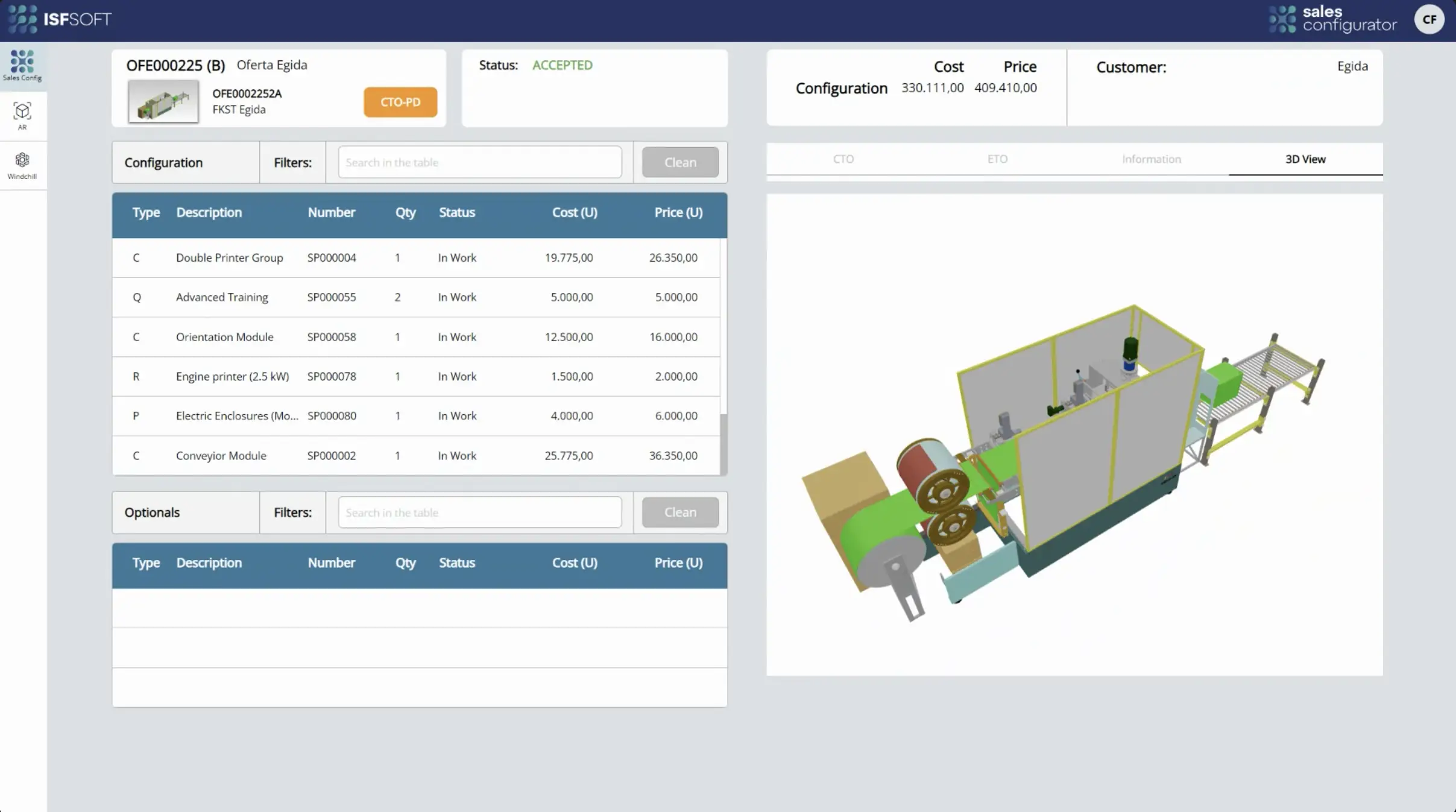
ISFsoft Sales Configurator is built specifically for this workflow: a CPQ solution designed for PTC Windchill environments, with native support for ETO and CTO processes. It allows sales teams to independently generate complete, technically valid quotes for complex customized products — without opening a support ticket with engineering.
What to look for in a CPQ for ETO/CTO environments
If you're evaluating CPQ options for a complex manufacturing context, these are the criteria that separate a useful solution from one that creates more problems than it solves:
Native PLM integration. The configurator should read product logic from your existing PLM — not require you to maintain a parallel dataset. In a Windchill environment, this means bi-directional integration, not just an export.
Constraint-based configuration. Rules that prevent invalid combinations must be enforced at the point of selection, not surfaced as errors after the fact.
Automatic eBOM and drawing generation. For the quote to be more than a commercial document, it should trigger the technical outputs engineering needs: structured BOM, updated CAD drawings, production-ready documentation.
Role-appropriate interface. Sales users shouldn't need to understand product architecture. The interface should guide, constrain, and present options in commercial terms.
Scalability across product complexity. Solutions that work for 10 variants often break at 1,000. Verify it against your actual product catalog, including your most complex configurations.
The deeper shift: from gatekeeping to enabling
The most durable benefit of giving sales teams configurator autonomy isn't the faster quote. It's the change in how your organization relates to its own product knowledge.
When configuration logic is encoded in a system — rather than locked in engineering heads — it becomes shareable, scalable, and consistent. A new sales hire can quote as accurately as a 10-year veteran on day one. A partner or distributor can configure products without calling your office. The commercial surface of your company expands without proportional headcount growth.
That's not a small thing in an industry where product complexity tends to grow faster than the teams managing it.
See it in action
ISFsoft Sales Configurator is designed for manufacturers running PTC Windchill who want to close the gap between sales and engineering — without losing technical accuracy or forcing expensive customization.
Explore ISFsoft Sales Configurator →
Or if you'd like to see how it handles your specific product configuration challenges:
Talk to our team →
ISFsoft is developed by ISF Innovation Experts, an official PTC technology partner. The ISFsoft suite extends PTC Windchill with purpose-built solutions for visualization, integration, spare parts management, and product configuration.


What is a sales configurator and how can it help your company?
In an increasingly competitive business environment, customizing products to meet customer needs has become a key success factor. Companies that manufacture and sell products under ETO (Engineer-to-Order) and CTO (Configure-to-Order) models face the challenge of offering tailored solutions efficiently and profitably. To address this, CPQ (Configure, Price, Quote) configurators have emerged as an essential tool for optimizing commercial and production processes.
What is a CPQ configurator?
A CPQ configurator is a software solution designed to streamline the configuration, pricing, and quoting processes for complex products. Its purpose is to facilitate the sale of highly configurable products while ensuring that each configuration complies with the company's established technical and commercial rules. This type of tool is particularly useful in industries such as industrial machinery, electronics, automotive, and advanced manufacturing.
Benefits of a CPQ configurator for ETO and CTO Companies
- Reduced response time: Automates the configuration and quoting process, enabling sales teams to generate proposals in minutes instead of days.
- Error elimination: By integrating business rules and technical constraints, it minimizes human errors in product configuration and quote generation.
- Profitability optimization: Allows for the implementation of smart pricing strategies, ensuring that every offer is both competitive and profitable.
- Enhanced customer experience: Customers receive fast and accurate proposals, strengthening trust in the company and accelerating sales closures.
- Integration with management systems: CPQ tools can connect with ERP, CRM, and PLM systems, ensuring data consistency throughout the product lifecycle.
What features should a good sales configurator have?
An efficient CPQ configurator should include the following features:
- Intuitive interface: Easy to use for sales teams, minimizing the learning curve and facilitating adoption.
- Flexible configuration rules: Ability to manage complex business rules and adapt to different configuration and pricing policies.
- Automatic document generation: Enables the quick and accurate creation of customized quotes and proposals.
- Integration with business systems: Connectivity with ERP, CRM, and PLM systems to ensure data and process consistency.
- Scalability and customization: Adaptability to different business needs and organizational growth.
- Approval workflow automation: Capability to establish approval rules for different hierarchical levels within the company.
ISFsoft Sales Configurator: A CPQ solution for PTC Windchill
For companies managing their products through PTC Windchill (PLM), the ISFsoft Sales Configurator stands out as an advanced CPQ solution. Designed to optimize product configuration, pricing, and quoting for ETO and CTO models, this configurator enables seamless integration with the PLM environment, ensuring consistency and traceability throughout the sales process.
Additionally, this tool empowers the sales department to independently configure offers and products, reducing reliance on the technical team and speeding up the sales cycle. With its ability to manage complex rules and generate automatic proposals, ISFsoft Sales Configurator helps companies reduce response times, improve quotation accuracy, and enhance commercial efficiency.