

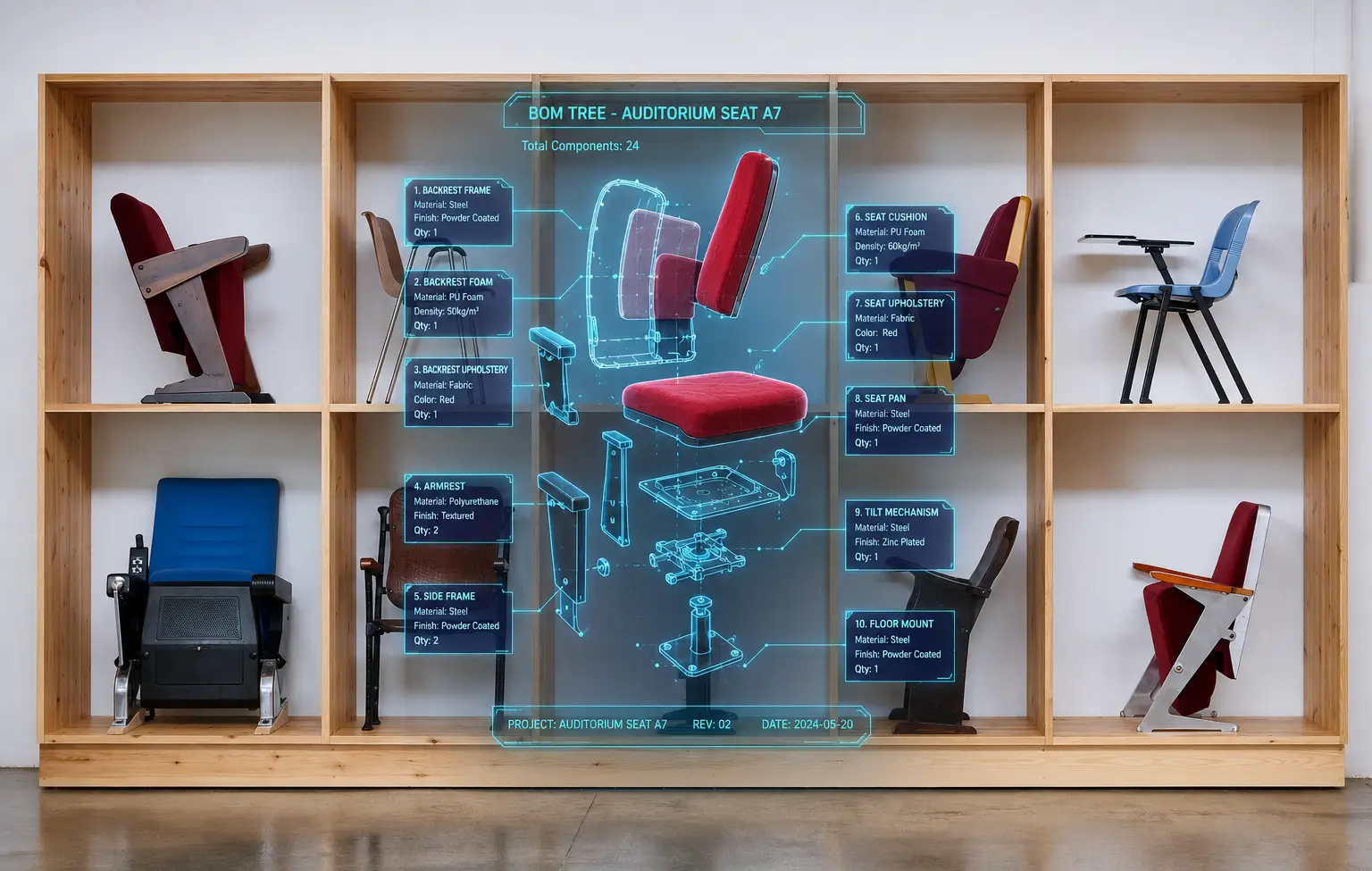
How Figueras Seating eliminated manual data management in Windchill without changing their PLM
There is a situation that many Windchill environments share, even in companies that have invested heavily in PLM: the system holds the data, but people are still doing the work of moving it.
Every new project triggers a wave of manual tasks. Items created one by one. BOMs copied and adjusted by hand. Files sent to suppliers without any guarantee they are the right version. And underneath it all, a Windchill environment quietly filling up with outdated and duplicated content that no one has time to clean.
This is not a technology problem in the sense that Windchill is broken. It is a workflow problem — and it tends to go unnoticed precisely because teams adapt to it. They build routines around the gaps. Until the volume grows too large, or a mistake costs too much, or someone stops to calculate how many engineering hours are spent on data management instead of engineering.
Figueras Seating reached that point.
A precision business with a manual data problem
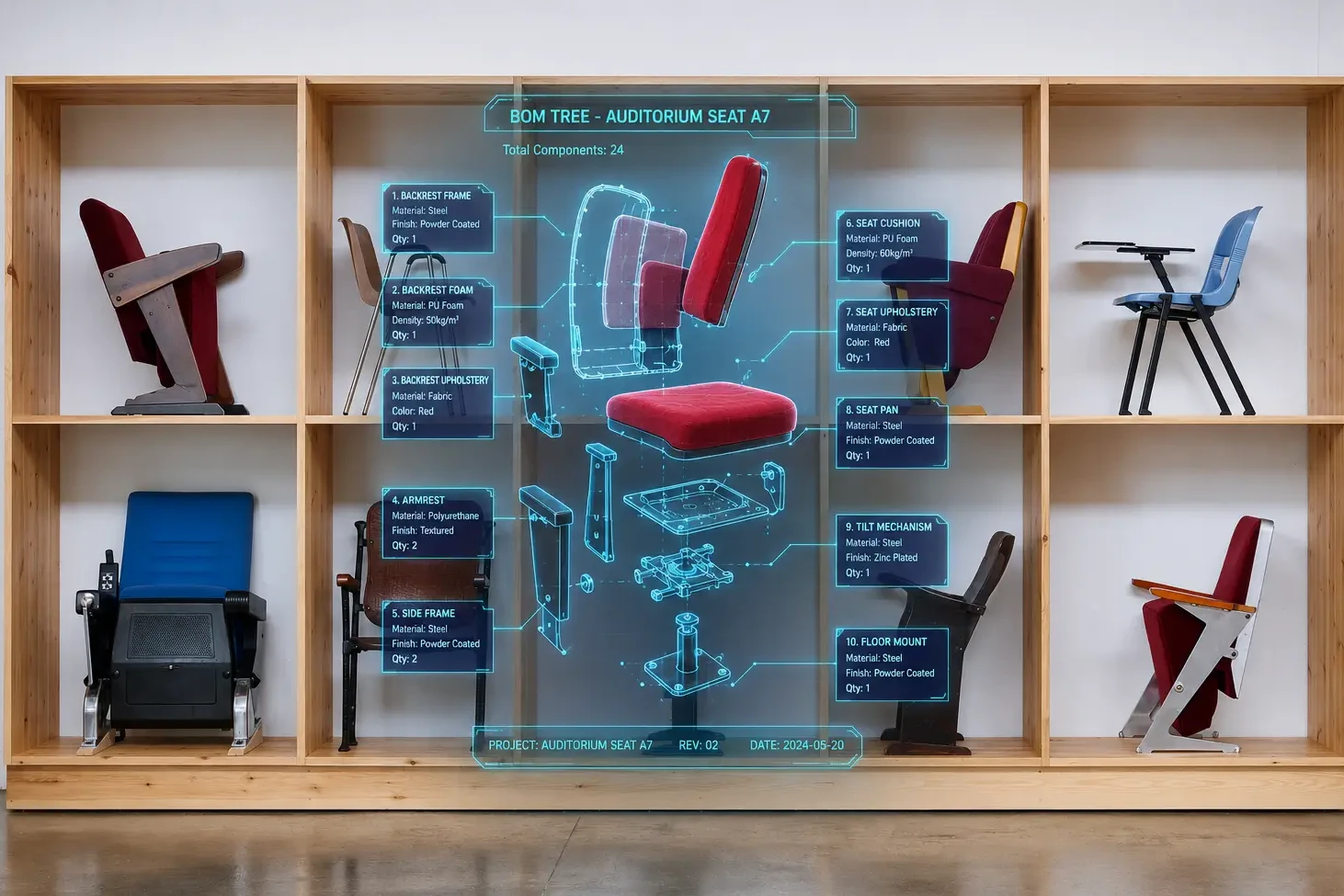
Figueras designs and manufactures premium seating for auditoriums, theatres, cinemas, and stadiums in more than 150 countries. Every installation is different: seat dimensions, curvature, positioning, and finish are all defined by the specific geometry of each venue. There is no off-the-shelf configuration — each project is a custom engineering exercise.
That level of customization generates a high volume of items, versions, and CAD documents. And for every project, that data had to be loaded manually into their ERP system (Microsoft Navision), with no automated connection between PLM and ERP.
The consequences were predictable, though no less costly for being so.
The four problems that were costing the most
1. Loading project data into Windchill and ERP was slow, manual, and error-prone
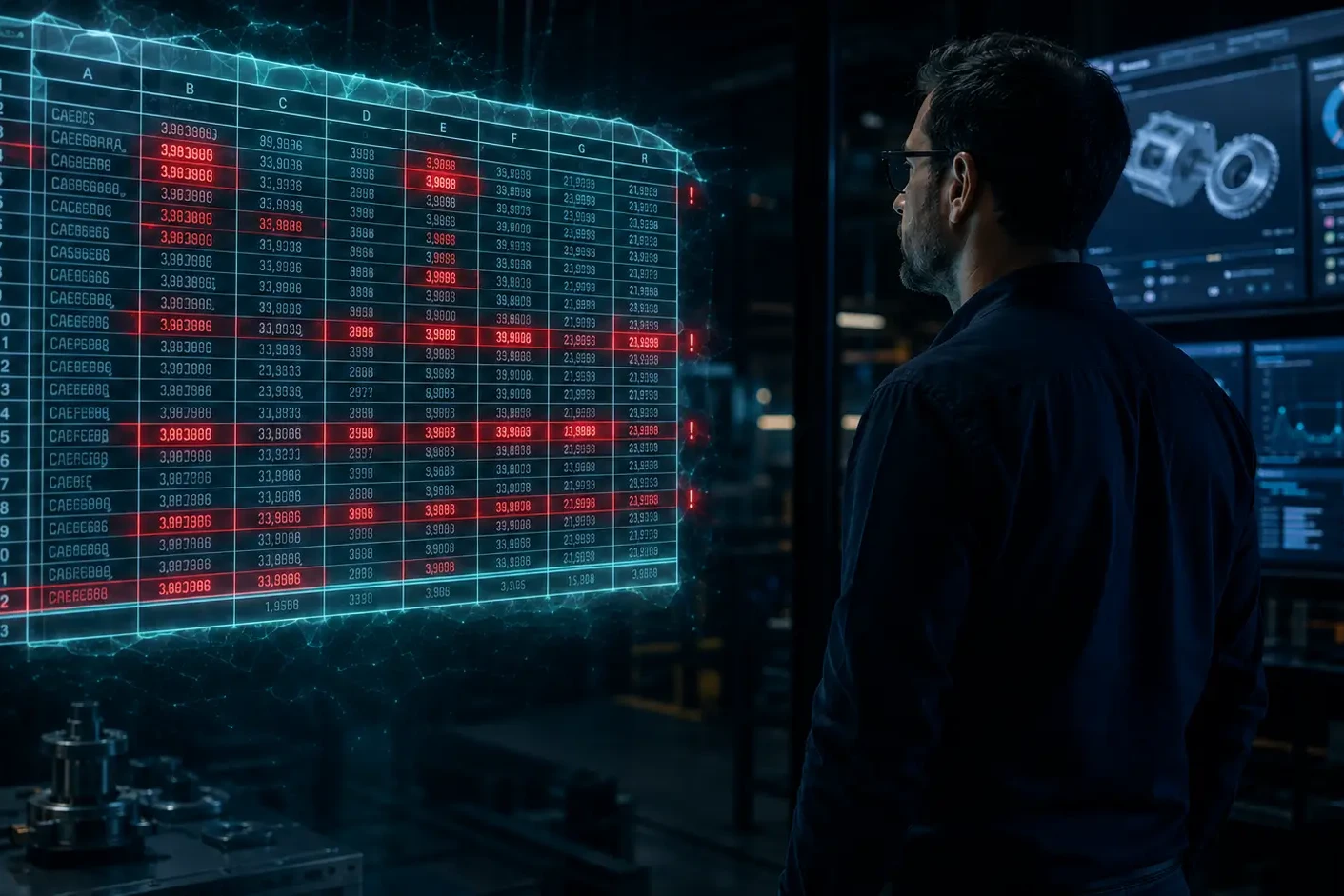
Each new project meant creating and updating items one by one across both systems. With complex, customized BOMs — where every seat in a venue can have its own configuration — the volume of manual input was significant. And manual input means inconsistencies: data that does not match between systems, items created with errors, versions that diverge.
The time cost was real. So was the risk. In a business where every installation is unique and tolerances are tight, a data error does not stay in a spreadsheet — it travels downstream into production.
2. Windchill was accumulating noise it could not clean itself
Without an automated and controlled flow for creating and updating items, obsolete and duplicated content builds up over time. Items that were replaced but never removed. Versions that should have been superseded but were not. A PLM environment that was meant to be the single source of truth was instead becoming a source of uncertainty.
Cleaning this manually is time-consuming and disruptive. Most teams deprioritize it. The noise grows.
3. Errors in data became errors in production
When the connection between engineering data and manufacturing is handled by people rather than systems, the margin for error is wide. An outdated BOM reaching the shop floor. A component specified incorrectly because the item in ERP did not reflect the latest version in Windchill. Rework, delays, costs that should not have been there.
In high-precision, high-customization manufacturing, the cost of a data error is not just the error itself — it is everything that flows from it before anyone catches it.
4. Suppliers and partners were working without version certainty
Distributing project documentation to external partners — suppliers, subcontractors, site teams — was done without a controlled mechanism to ensure they always received the correct, current files. 2D drawings and 3D models sent outside Windchill lose their connection to the source. Someone builds from a drawing that has since been updated, and no one necessarily knows until it becomes a problem on site.
What changed with Windchill Utilities
Two applications from the Windchill Utilities suite addressed these problems directly.
Bulk Creation & Update Tools introduced an automated, Excel-driven interface between Windchill and Navision. Instead of creating and updating items manually in each system, the team now manages data through a structured process that keeps both platforms consistent. The Windchill mBOM and the ERP BOM for each project stay aligned, without manual synchronization.
Download Baseline Components gave the team a controlled mechanism for distributing project documentation externally. Files — primary content, attachments, and object representations — are grouped into structured baselines directly from Windchill, ensuring that suppliers and partners always receive the correct version of 2D and 3D files. Windchill remains the single, authoritative source.
The results
- Manual input eliminated across complex, customized BOMs — significantly reducing both time and errors when loading project data.
- Obsolete and duplicated items no longer accumulate, removing the overhead of periodic cleanup and restoring confidence in the PLM environment.
- Fewer errors reaching production, with a direct impact on rework costs, delivery speed, and product quality.
- Suppliers and partners always receive the correct, up-to-date file versions — distributed directly from Windchill baselines.
- A stable, maintainable environment that can evolve alongside both Windchill and ERP without accumulating technical debt.
Is your team spending engineering hours on data management?
If any of the situations above feel familiar, the gap is likely not in your PLM platform — it is in the workflow connecting it to the rest of your operation.
Windchill Utilities by ISFsoft is a suite of productivity applications designed to automate routine tasks, eliminate manual data management, and keep your Windchill environment clean, consistent, and ready to scale.
Explore Windchill Utilities →
See how other manufacturers are working smarter with Windchill
Figueras is not the only company that has transformed the way it manages engineering data. Explore more real-world examples of how ISFsoft helps manufacturing teams eliminate inefficiencies, connect their systems, and get more out of their PLM investment.
Explore all case studies →

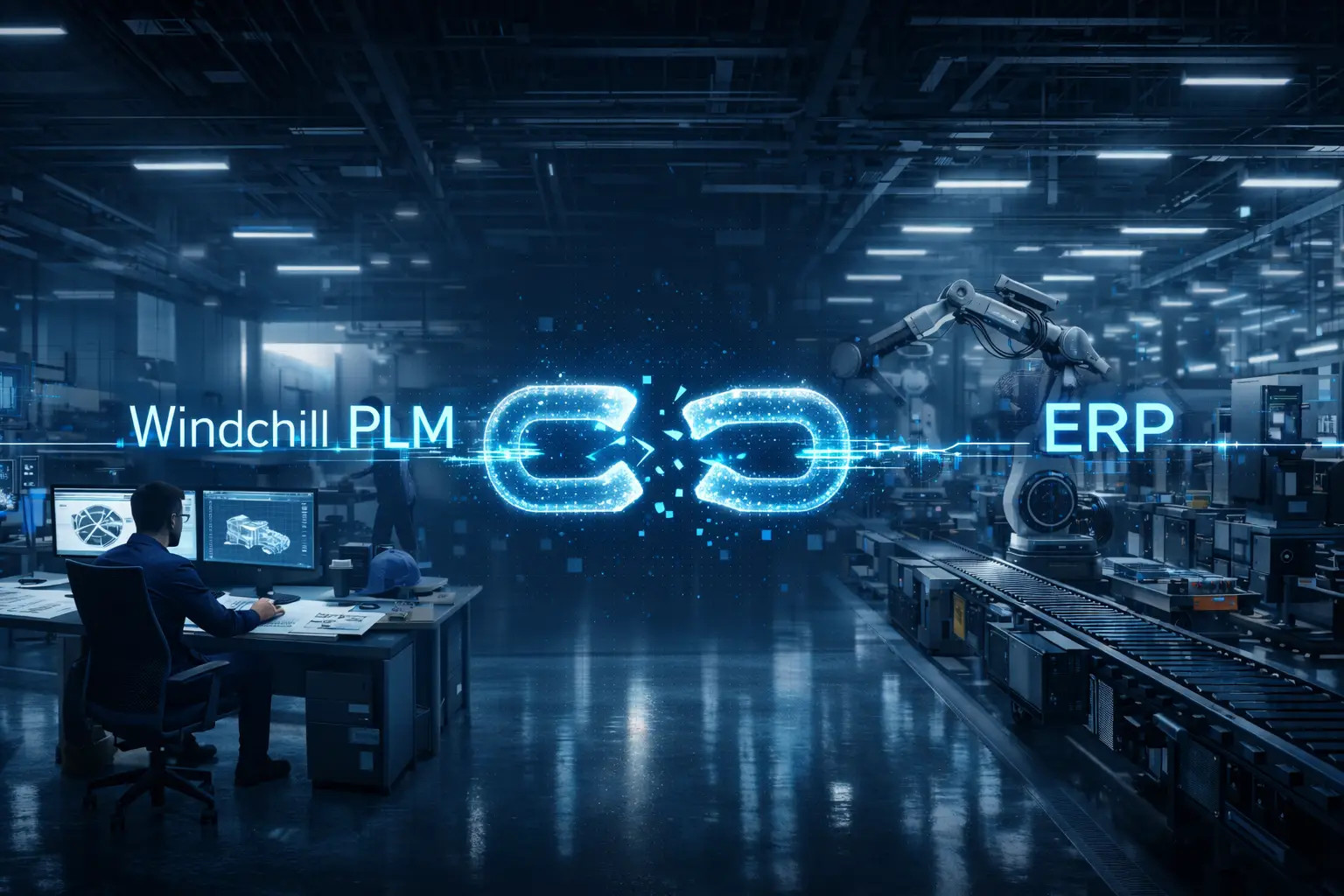
The hidden cost of disconnected Windchill PLM and ERP systems in manufacturing
Digital transformation in manufacturing often begins with the implementation of powerful platforms such as Windchill PLM and a robust ERP system. On paper, the technological landscape looks complete: engineering manages product structures and revisions in Windchill PLM, while operations, procurement and finance rely on ERP to plan and execute production.
However, in many industrial organizations these systems do not truly operate as one.
When Windchill PLM and ERP are not properly integrated, the gap between engineering and operations quickly becomes a structural weakness. What initially appears to be a technical limitation gradually turns into an operational problem that affects cost control, product quality and time-to-market.
The operational risk of disconnected systems
Modern product development is significantly more complex than it was just a decade ago. Companies design products that combine mechanical components, electronics and software while coordinating engineering teams, suppliers and manufacturing sites across multiple locations and time zones.
In this context, product information cannot remain isolated inside engineering tools.
When Windchill PLM operates independently from ERP, the organization begins to fragment. Engineering defines product structures and revisions in Windchill PLM that production may not immediately see reflected in ERP, while manufacturing teams update operational data that rarely flows back into engineering environments. Procurement and finance may therefore work with cost or planning data that does not fully match the latest design reality.
The result is not immediate chaos, but a gradual accumulation of inefficiencies. Manual exports, spreadsheet bridges, duplicated data entries and email confirmations become routine practices that compensate for the lack of system synchronization.
Over time, these workarounds create a fragile operational model that slows the organization down.
BOM inconsistencies: the most visible symptom
One of the areas most affected by the lack of integration between Windchill PLM and ERP is the Bill of Materials. The BOM represents the backbone of manufacturing operations, connecting engineering design with procurement, planning and production.
When BOM structures or revisions must be transferred manually between Windchill PLM and ERP, inconsistencies inevitably appear. A component revision may be outdated, a variant configuration may be incomplete, or a manufacturing process may not reflect the most recent engineering change.
These inconsistencies quickly move beyond the system and into the shop floor. Production errors increase, rework becomes more frequent and inventory levels grow unnecessarily because outdated or incorrect data drives operational decisions.
What initially appears to be a minor data synchronization issue can therefore translate into measurable financial impact and operational inefficiency.
Engineering changes without synchronization
Engineering Change Notices and Engineering Change Orders are essential for controlling product evolution. Windchill PLM provides the structure and traceability needed to manage these changes, but the benefits disappear if the changes are not automatically synchronized with ERP.
Without integration, production may continue manufacturing based on obsolete revisions while procurement orders components tied to previous versions of the product. Project schedules may also fail to reflect the real impact of engineering modifications.
In global manufacturing environments where production operates continuously, this lack of synchronization increases operational risk and complicates compliance and traceability requirements.
More importantly, it undermines confidence in enterprise data. When teams cannot fully trust the information available in their systems, decision-making slows down and additional validation steps become necessary before moving forward.
The hidden impact on time-to-market
Many organizations believe their time-to-market challenges come from product complexity or limited resources. In reality, the underlying problem is often data inconsistency between Windchill PLM and ERP.
Before launching a product, teams frequently spend significant time verifying that engineering data and manufacturing structures match across systems. They review BOM revisions, validate routing information and manually reconcile discrepancies that appear between platforms.
These activities do not contribute to innovation or product improvement. Instead, they compensate for disconnected systems.
When Windchill PLM and ERP are properly integrated, synchronization becomes automatic and the number of data errors decreases significantly. As a result, product launches move faster because teams can focus on engineering and manufacturing decisions instead of resolving system inconsistencies.
Integration as a strategic capability
Integrating Windchill PLM with ERP is not simply a technical improvement but a fundamental step toward operational coherence. When engineering, manufacturing and business systems are properly connected, product information flows consistently across the organization and teams can rely on a single source of truth.
This alignment allows companies to reduce errors, improve collaboration and accelerate decision-making while maintaining full traceability of product and manufacturing data.
In modern manufacturing environments where complexity continues to grow, the integration between Windchill PLM and ERP has become a critical capability rather than an optional improvement. Organizations that succeed in connecting these systems are not only improving their IT architecture; they are strengthening the foundation that supports their entire product lifecycle and operational performance.
This is precisely the role of ISFsoft Connect. Designed as an integration platform between Windchill PLM and ERP systems, ISFsoft Connect enables organizations to synchronize product data, engineering changes, manufacturing structures and operational information across systems in a controlled and traceable way. By creating a reliable bridge between engineering and operations, companies can eliminate manual data transfers, reduce inconsistencies and ensure that product information flows seamlessly across the entire organization.
Discover how ISFsoft Connect helps companies integrate Windchill PLM with ERP systems and build a truly connected manufacturing environment >>

From engineering data to production control: aligning Windchill and ERP in high-growth manufacturing
In Barcelona, Stark Future is redefining performance in the electric motorcycle industry. With more than 100 engineers and operating in one of the fastest-growing segments of the global EV market, the company combines engineering excellence with an ambitious growth strategy. But in high-velocity manufacturing environments, innovation alone is not enough. Without structural control, growth quickly exposes weaknesses in data management and system integration.
At a critical stage of its expansion, Stark Future faced a challenge that is common in fast-scaling industrial companies: how to transform engineering data into production-ready structures without losing accuracy, traceability or time.
The challenge: aligning Windchill with ERP reality
Stark Future’s engineering environment was based on Windchill PLM from PTC, where product structures were defined and managed as Engineering Bills of Materials (EBOM). However, translating those EBOMs into Manufacturing Bills of Materials (MBOM) ready for production — and reliably connecting that information to Microsoft Dynamics ERP — was not automated.
The transition relied heavily on manual data handling. Engineering and manufacturing teams were not fully synchronized at system level, and changes required effort to track and validate. In practice, this meant product structures were exposed to inconsistencies, delays and operational risk. At the pace Stark Future was growing, this gap between PLM and ERP could quickly become a structural bottleneck.
The problem was not the quality of engineering. It was the absence of a controlled, automated integration layer between Windchill and the ERP.
The solution: structured integration with ISFsoft Connect
To address this challenge, ISFsoft Connect was introduced as the integration layer between Windchill and Microsoft Dynamics. The objective was clear: establish a structured, automated and governed data flow between engineering and manufacturing, eliminating manual intervention wherever possible.
The project began with a thorough pre-analysis phase to define scope, risks and integration requirements. Particular attention was given to defining precise EBOM-to-MBOM transformation rules, ensuring that what engineering designed in Windchill could be consistently and accurately translated into a manufacturing structure aligned with ERP processes.
Rather than treating PLM and ERP as separate initiatives, the approach aligned both environments from the outset. The integration ensured that product releases, revisions and changes could move between systems in a controlled and traceable way, creating a reliable digital thread across the organization.
The focus was not limited to technical connectivity. It was about long-term reliability and scalability. In high-growth contexts, short-term fixes create long-term instability. The objective was to build a foundation capable of supporting Stark Future’s expansion without constant rework or manual corrections.
The impact: a single source of truth at a decisive moment
The results were structural. Stark Future established a reliable method to derive MBOM from EBOM, fully connected to the ERP and free from manual duplication. Errors associated with manual data entry during product structure development were eliminated. Product releases became instantly controlled, and change management gained full traceability across systems.
Most importantly, the company achieved what every fast-growing manufacturer needs: a single source of truth between Windchill and ERP. Engineering and manufacturing now operate on synchronized data, reducing risk and increasing operational confidence at a critical stage of growth.
In industries evolving as rapidly as electric mobility, scalability depends on integration discipline. Stark Future’s case demonstrates that aligning Windchill with ERP through a structured integration layer is not simply a technical improvement — it is a strategic enabler of controlled growth.
If your company uses Windchill and is struggling to reliably integrate it with your ERP, we can help you design a controlled, scalable integration strategy. Contact ISFinnovation to explore how to eliminate manual bottlenecks and establish a true digital backbone between PLM and ERP.