



From Excel to digital portal: Improving spare parts management in industrial environments
For many industrial companies, managing spare parts still depends on endless spreadsheets, manual updates, and long email threads between departments. While Excel has long been a trusted ally, it was never designed for the complexity of modern after-sales operations, where accuracy, visibility, and responsiveness are essential. Transitioning from traditional spreadsheets to a digital spare parts portal is not just a technological step forward — it represents a true transformation in the way organizations handle information, collaborate across teams, and serve their customers.
The Limits of Manual Management
Managing spare parts manually often seems simple at first. Spreadsheets are familiar, flexible, and inexpensive. But as product lines expand and the number of components increases, the cracks start to show. Data becomes fragmented across different files and versions, often inconsistent or outdated. Each manual edit increases the likelihood of human error, from incorrect references to duplicated items or missing information. Over time, the lack of version control and traceability makes it difficult to maintain quality or accountability, and operations begin to slow down as users spend more time searching for information than acting on it.
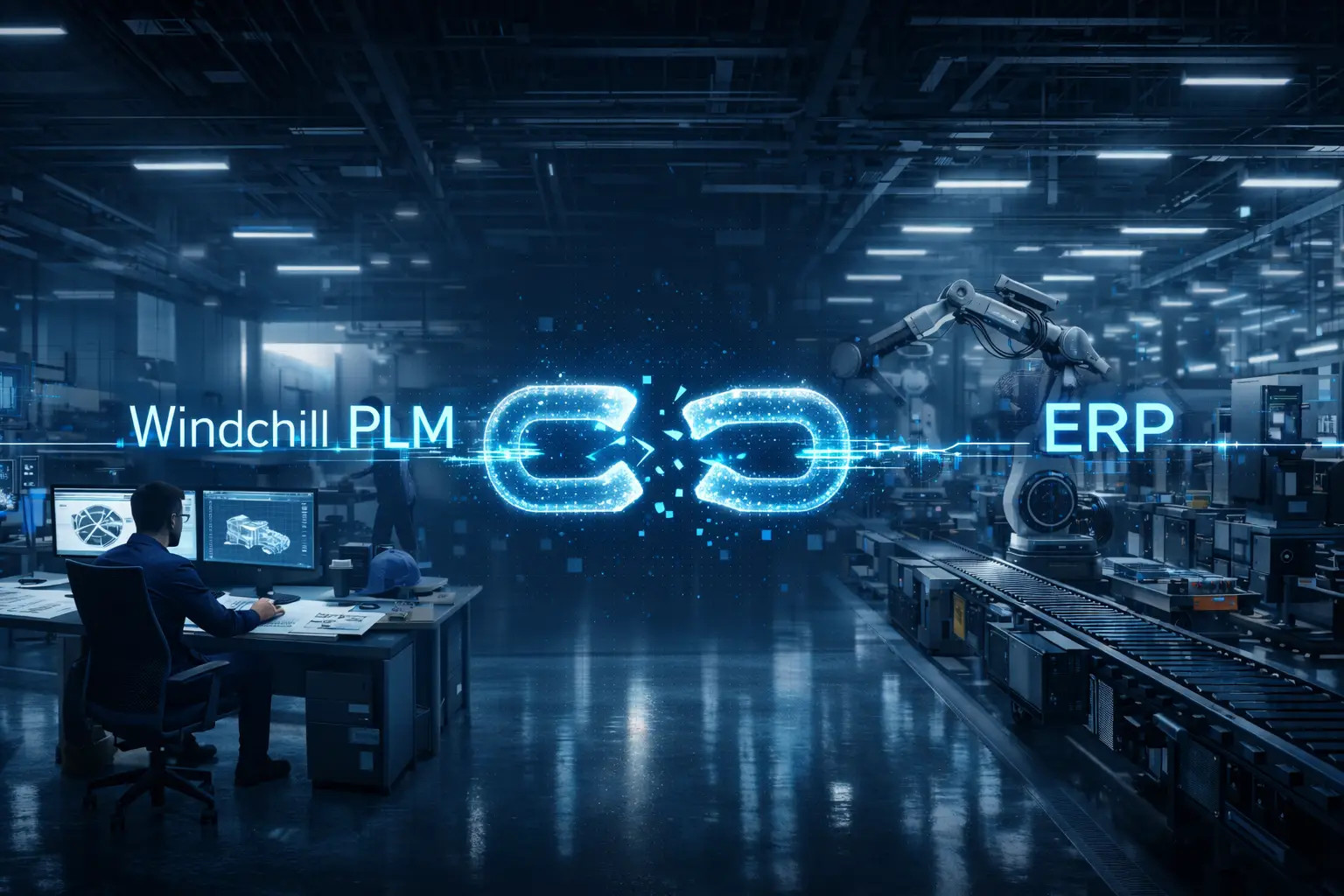
Another major challenge is the absence of real-time synchronization with core systems such as PLM or ERP. Engineering teams may update part numbers or documentation, but those changes rarely flow automatically to after-sales or logistics teams. This disconnect leads to inefficiency, errors in orders, and frustration both internally and for customers who rely on accurate information. In short, spreadsheet-based management is not scalable. It restricts visibility and collaboration precisely when industrial operations require both.
The Shift to a Digital Spare Parts Portal
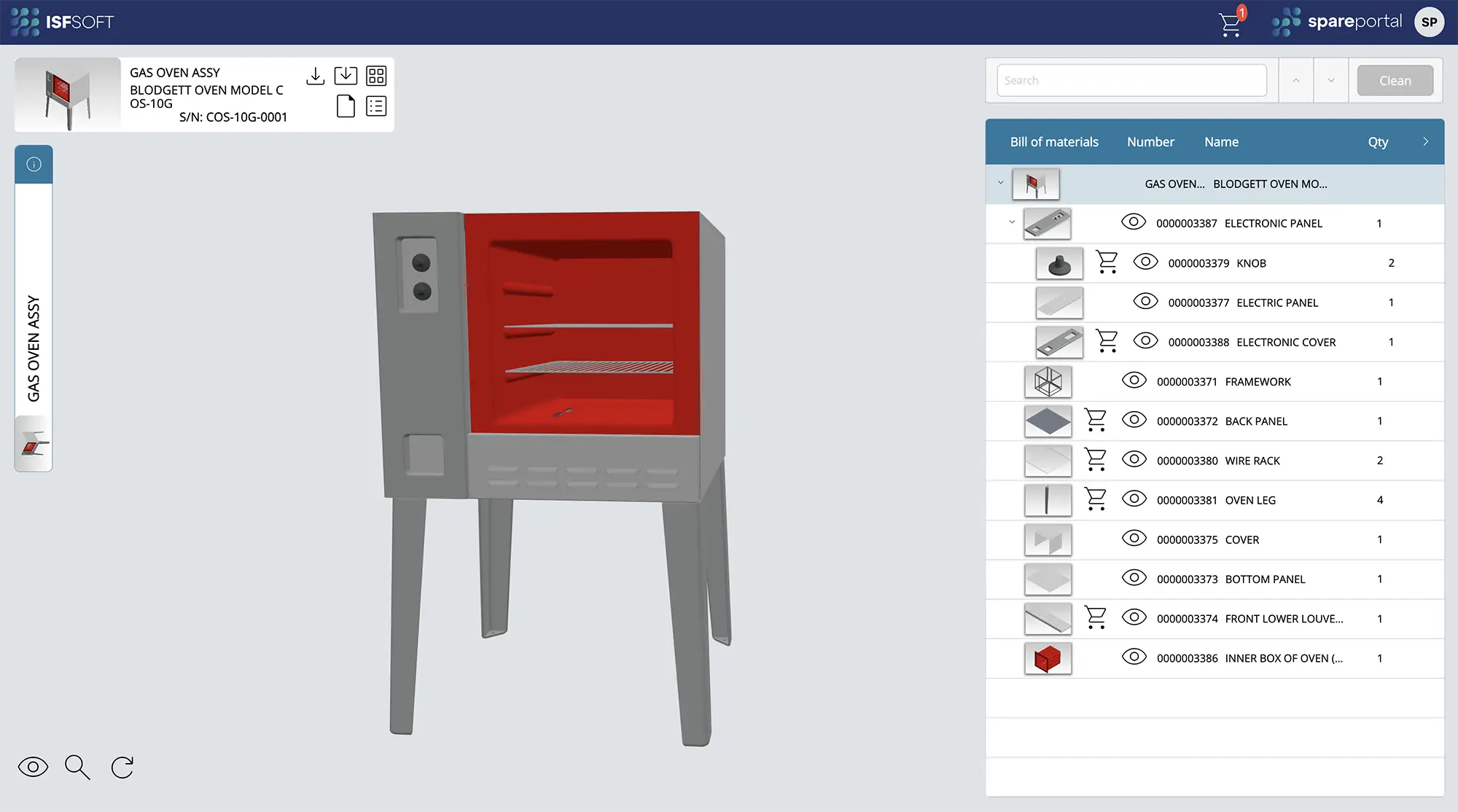
Replacing spreadsheets with a digital spare parts portal means centralizing all critical product data — from 3D assemblies and technical documentation to live stock and version history — within a single, secure platform. It’s a shift from static data to a dynamic, connected system that evolves in real time. With a solution like ISFsoft Spare Portal, every stakeholder involved in the after-sales process can access consistent, accurate, and visually intuitive information.
Technicians can identify parts directly from 3D or exploded views, avoiding confusion between similar components. Engineering updates made in Windchill automatically synchronize with the portal, ensuring that part numbers, documentation, and availability are always up to date. At the same time, customers and distributors gain access to a modern self-service interface where they can search for products, confirm compatibility, and even place orders online without depending on manual intervention. The result is a leaner, faster, and far more reliable process for everyone involved.
Real-World Impact: From Reactive to Predictive
Consider the case of an industrial equipment manufacturer that manages thousands of spare parts across multiple product lines. In the traditional model, technicians spent hours navigating through Excel sheets, cross-checking codes, and validating availability manually. Mistakes were common, and each incorrect order meant delays, extra costs, and dissatisfied clients. After implementing ISFsoft Spare Portal, the company achieved a single source of truth for all spare parts data, seamlessly integrated with Windchill and the ERP system. Technicians now locate the right components in seconds, customers can view up-to-date product information, and service teams no longer rely on email chains to confirm compatibility.
This transition didn’t just reduce errors and lead times — it changed the way the company operates. Instead of reacting to issues as they arise, they can now anticipate demand, track version changes automatically, and plan inventory with greater precision. In other words, they moved from a reactive to a predictive service model.
Beyond Efficiency: Building a Connected After-Sales Ecosystem
Digitalizing spare parts management goes far beyond administrative efficiency. It is the foundation of a connected after-sales ecosystem where information flows freely between engineering, logistics, and service. When the spare parts portal communicates directly with PLM and ERP systems, any change made in design or production is immediately reflected across the entire service network. This ensures full alignment and eliminates the need for repetitive data entry, freeing teams to focus on value-added tasks.
Moreover, the integration of real-time data opens the door to advanced capabilities such as predictive maintenance, automated reporting, and data-driven decision-making. Each interaction within the portal generates insights that can improve product design, optimize inventory, and strengthen customer relationships. The shift from isolated spreadsheets to a digital platform ultimately transforms the after-sales function into a strategic asset for the business.
ISFsoft Spare Portal: The Next Step in Your Digital Journey
At ISF Innovation Experts, we believe that the digital thread should not end with manufacturing. Knowledge created in the design and engineering phases should extend all the way to after-sales service, where it delivers tangible value for customers and service teams alike. ISFsoft Spare Portal was developed with this vision in mind — connecting engineering data, service processes, and customer needs through a single digital platform.
By adopting ISFsoft Spare Portal, manufacturers can take a decisive step toward complete lifecycle digitalization, improving accuracy, collaboration, and customer experience. It’s not just about replacing Excel. It’s about creating a smarter, connected, and sustainable way to manage your after-sales operations.


From PLM to after-sales: Extending the digital thread with ISFsoft and PTC Windchill
Bridging the Gaps: Specialized Tools for a Complete Digital Thread
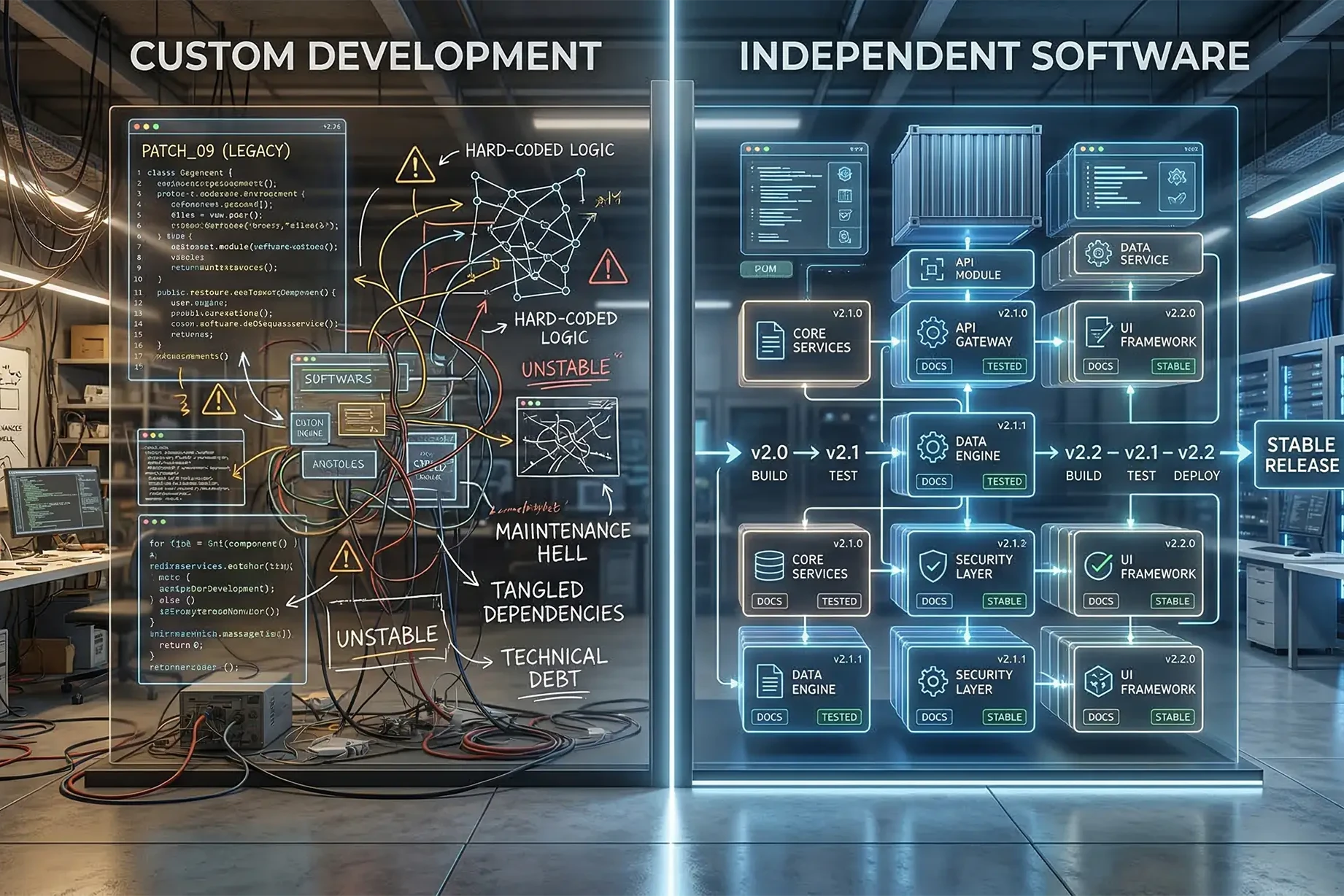
PTC’s Windchill PLM is a powerful foundation for managing engineering data. ISFsoft enhances that foundation with targeted capabilities that connect Windchill to downstream processes and external systems—making the digital thread operational beyond the PLM core.
1. Connect: Synchronizing Windchill and ERP
ISFsoft Connect is an Enterprise Service Bus (ESB) that serves as the backbone of integration between Windchill and your ERP system. It ensures consistent, real-time data flow between engineering and business operations—bridging BOMs, part metadata, documentation, and lifecycle statuses across systems.
This connection eliminates manual duplication, ensures traceability, and enables better planning, procurement, and production alignment.
2. Sales & Product Configurator: From Engineering Rules to Commercial Offers
Our Product Configurator transforms engineering rules into configurable product logic, enabling accurate and error-free product definition.
The Sales Configurator uses that logic to generate customized offers, automatically aligned with engineering constraints and PLM data—reducing lead times and preventing costly misconfigurations.
Together, they bridge the gap between engineering and sales, streamlining the configure-to-order process and enhancing customer responsiveness.
3. Viewer: Visualizing Engineering Data with Precision
ISFsoft Viewer empowers technical and non-technical users to interact with complex 3D assemblies linked to Windchill. It provides instant access to exploded views, part metadata, and automated technical documentation.
This visual clarity improves communication between departments and reduces dependency on CAD experts—extending the value of engineering data throughout the organization.
4. Spare Portal: Elevating the After-Sales Experience
ISFsoft Spare Portal extends the digital thread to the post-sales environment. It allows customers and technicians to visually identify spare parts, place orders online, and access version-controlled product information—always synced with Windchill data.
The result: faster service, fewer errors, and a superior after-sales experience that boosts customer satisfaction and retention.
Enabling End-to-End Continuity
The strength of the digital thread lies in its connectivity, accuracy, and completeness. ISFsoft acts as a strategic layer over the PTC ecosystem—ensuring that the data created in engineering is not only preserved, but also leveraged across the product lifecycle.
From syncing your PLM and ERP systems, to simplifying complex configurations, enhancing 3D data usage, and digitizing spare parts management—we help companies go beyond PLM to achieve a fully integrated digital enterprise.
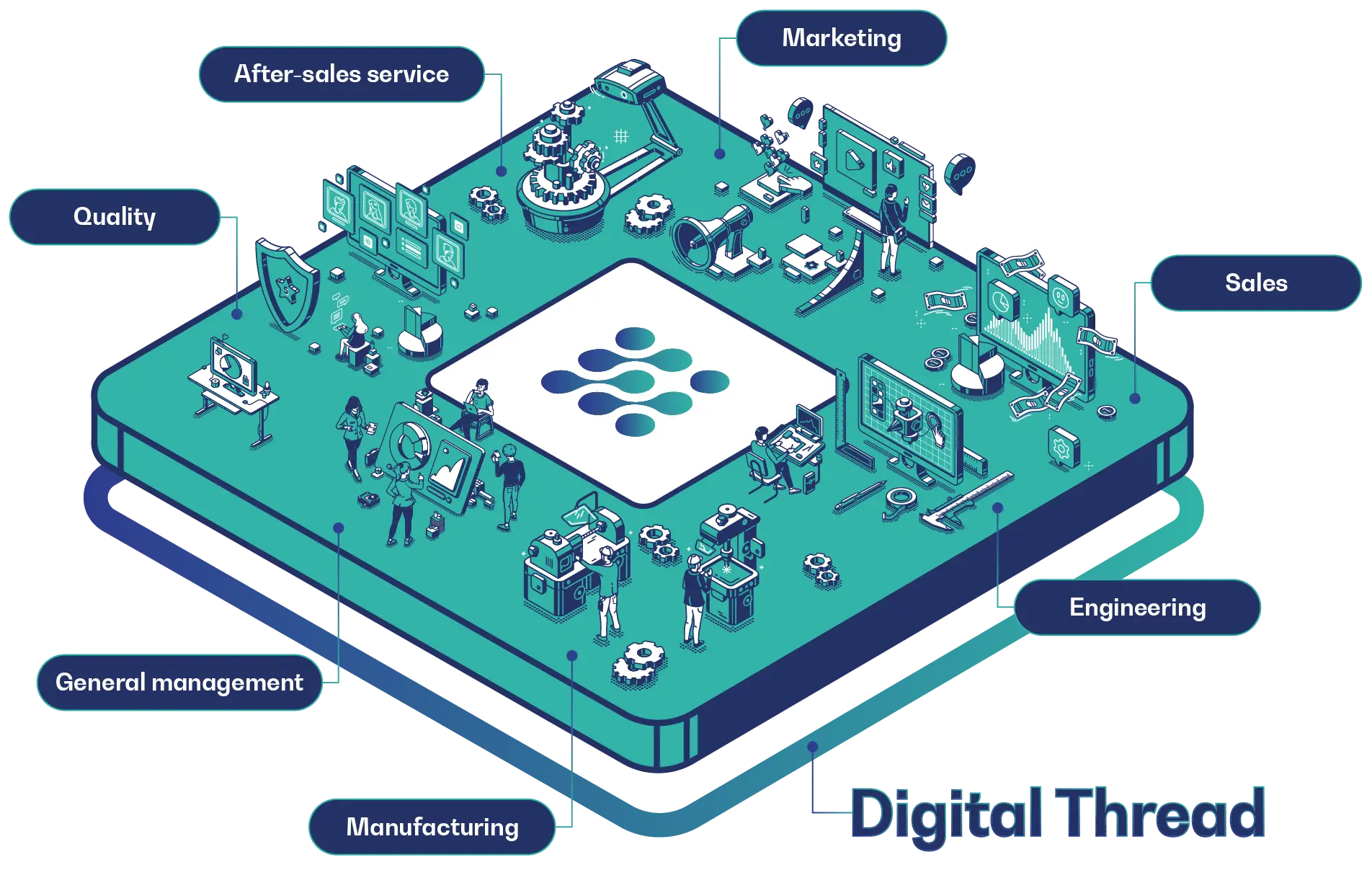
ISFsoft + PTC: Your End-to-End Digital Thread Partner
Digital transformation is not about isolated tools—it’s about creating a continuous flow of intelligence across your business. By complementing Windchill with specialized, interoperable solutions, ISFsoft empowers manufacturers to make real-time decisions, streamline operations, and deliver better service.
Together with PTC, we turn disconnected processes into connected value.

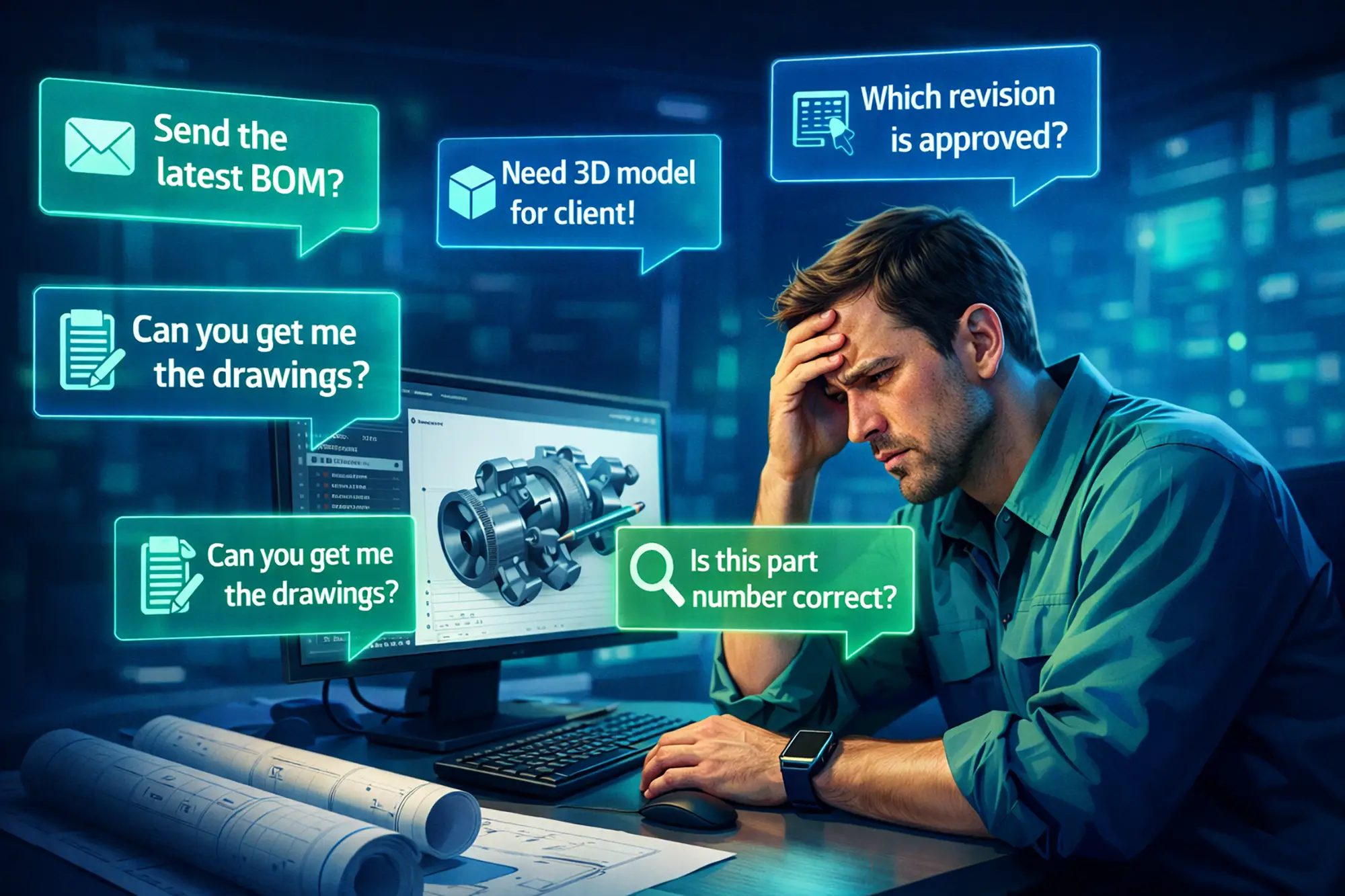
Why is access to information the biggest bottleneck in engineering?
The hidden costs of isolated engineering information
When engineering data is not accessible to the entire organization, the negative effects become immediately evident. Engineering teams turn into bottlenecks, constantly interrupted by information requests from other departments. This not only diverts their attention from essential innovation and development tasks but also creates a fragmented and inefficient workflow. The time lost responding to emails, attending calls, or generating specific content for other teams directly impacts the company’s productivity and agility.
The weaknesses of inaccessible engineering information
- Data duplication: Lack of access to updated information leads to the unnecessary creation of documents and files, resulting in redundancies and wasted resources.
- Proliferation of parts: Without a centralized view, different departments may generate similar or duplicate parts, hindering standardization and increasing operational complexity.
- Rework costs: Lack of access to reliable information leads to avoidable errors, requiring tasks to be redone, draining time and budget.
- Slowed innovation: Limited information flow between teams reduces the speed at which products can be developed and improved.
- Poor collaboration: Without a shared database, teams work with outdated or partial information, leading to poor decisions and missed opportunities.
- Longer development time: Fragmented information causes delays in design and manufacturing cycles, affecting the company’s competitiveness.
- Delayed time-to-market: Difficulty in accessing and sharing data affects responsiveness to market changes and opportunities, potentially leading to a loss of competitive advantage.
Inefficiency, overhead costs, and delays: The Price of Isolated Information
The lack of accessibility to engineering data has tangible consequences that directly impact operational efficiency and profitability:
- Lower productivity: Time spent searching for or requesting information translates to fewer hours dedicated to innovation and product development.
- Additional costs: Duplicated efforts and rework increase operating expenses.
- Innovation delays: Inefficient information flows extend development cycles.
- Higher error margin: The absence of a single, reliable source of information increases the risk of inconsistencies and product failures.
Data democratization: The key to optimizing processes and enhancing collaboration
To overcome these challenges, companies must invest in controlled and secure access to engineering information. This transformation of internal processes helps correct the previously mentioned weaknesses:
- Optimized resources and efficiency: Eliminating data duplication and facilitating access to accurate information allows teams to work more efficiently, reducing administrative time and maximizing productivity.
- Faster innovation and development: A smooth and transparent data flow enables better collaboration between departments, driving creativity and continuous improvement in design and production processes.
- Improved decision-making: Access to key information ensures that different departments work in alignment with up-to-date and reliable data, reducing errors and response times.
The solution: ISFsoft Viewer – Simplified Access and visualization of engineering data
To address the inefficiencies caused by limited access to engineering data, we have developed ISFsoft Viewer, an innovative solution that provides seamless access and visualization of critical Windchill information on a single, intuitive platform.
With ISFsoft Viewer, teams can:
- Quickly search for and access the information they need, without barriers or dependencies on other departments.
- Reduce time spent on administrative tasks, allowing engineers to focus on innovation and development.
- Enhance collaboration and decision-making by providing real-time, precise, and easily accessible data.
Eliminating barriers to engineering information access not only optimizes internal processes but also drives efficiency and innovation. With ISFsoft Viewer, companies can transform their data management approach, enabling each team to focus on what truly matters: developing high-quality products and achieving operational excellence.

What is a sales configurator and how can it help your company?
In an increasingly competitive business environment, customizing products to meet customer needs has become a key success factor. Companies that manufacture and sell products under ETO (Engineer-to-Order) and CTO (Configure-to-Order) models face the challenge of offering tailored solutions efficiently and profitably. To address this, CPQ (Configure, Price, Quote) configurators have emerged as an essential tool for optimizing commercial and production processes.
What is a CPQ configurator?
A CPQ configurator is a software solution designed to streamline the configuration, pricing, and quoting processes for complex products. Its purpose is to facilitate the sale of highly configurable products while ensuring that each configuration complies with the company's established technical and commercial rules. This type of tool is particularly useful in industries such as industrial machinery, electronics, automotive, and advanced manufacturing.
Benefits of a CPQ configurator for ETO and CTO Companies
- Reduced response time: Automates the configuration and quoting process, enabling sales teams to generate proposals in minutes instead of days.
- Error elimination: By integrating business rules and technical constraints, it minimizes human errors in product configuration and quote generation.
- Profitability optimization: Allows for the implementation of smart pricing strategies, ensuring that every offer is both competitive and profitable.
- Enhanced customer experience: Customers receive fast and accurate proposals, strengthening trust in the company and accelerating sales closures.
- Integration with management systems: CPQ tools can connect with ERP, CRM, and PLM systems, ensuring data consistency throughout the product lifecycle.
What features should a good sales configurator have?
An efficient CPQ configurator should include the following features:
- Intuitive interface: Easy to use for sales teams, minimizing the learning curve and facilitating adoption.
- Flexible configuration rules: Ability to manage complex business rules and adapt to different configuration and pricing policies.
- Automatic document generation: Enables the quick and accurate creation of customized quotes and proposals.
- Integration with business systems: Connectivity with ERP, CRM, and PLM systems to ensure data and process consistency.
- Scalability and customization: Adaptability to different business needs and organizational growth.
- Approval workflow automation: Capability to establish approval rules for different hierarchical levels within the company.
ISFsoft Sales Configurator: A CPQ solution for PTC Windchill
For companies managing their products through PTC Windchill (PLM), the ISFsoft Sales Configurator stands out as an advanced CPQ solution. Designed to optimize product configuration, pricing, and quoting for ETO and CTO models, this configurator enables seamless integration with the PLM environment, ensuring consistency and traceability throughout the sales process.
Additionally, this tool empowers the sales department to independently configure offers and products, reducing reliance on the technical team and speeding up the sales cycle. With its ability to manage complex rules and generate automatic proposals, ISFsoft Sales Configurator helps companies reduce response times, improve quotation accuracy, and enhance commercial efficiency.
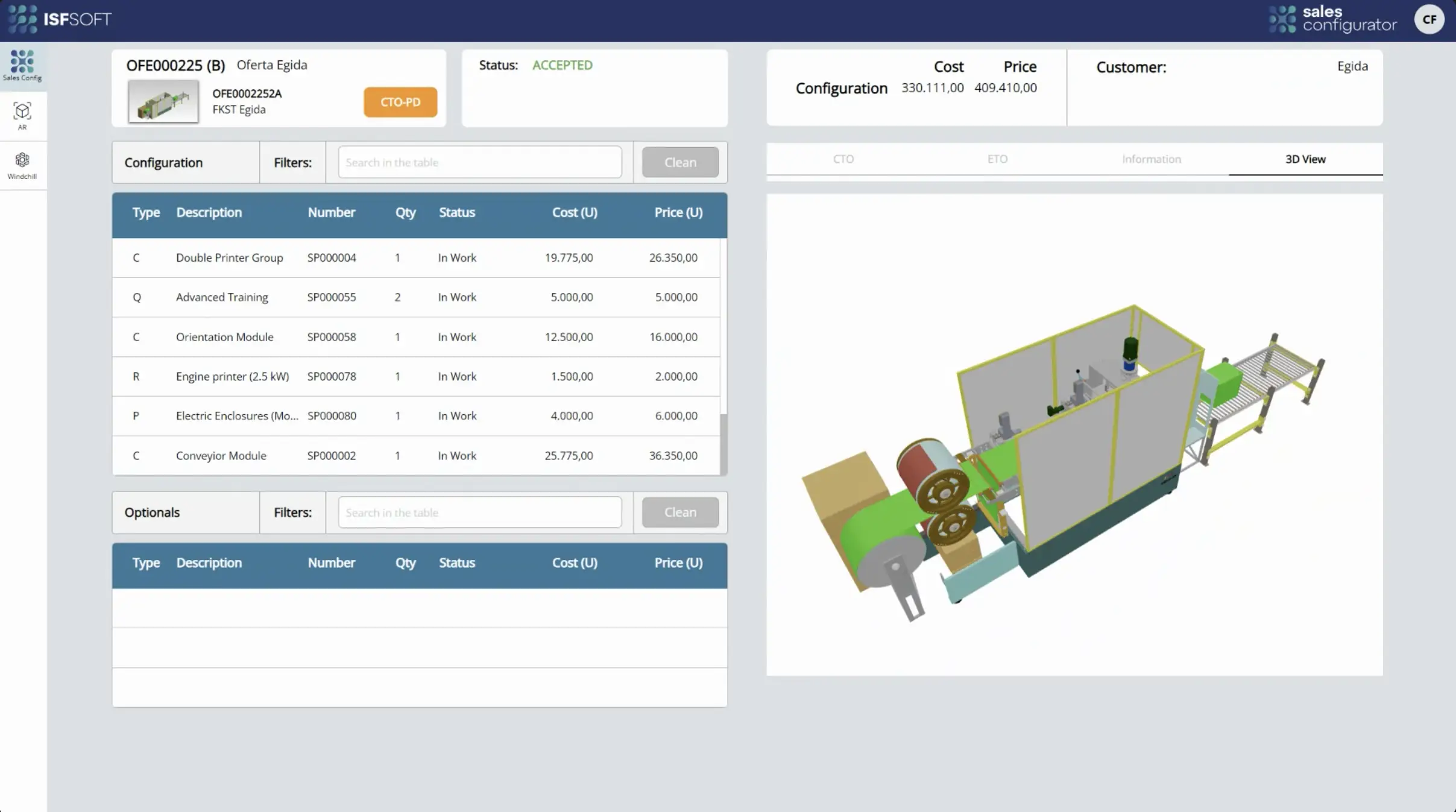

EGIDA: Driving digital transformation in manufacturing SMEs through augmented digital intervention
In an era where digital transformation is no longer a luxury but a necessity, especially amidst healthcare crises and mobility constraints, the EGIDA - Estrategia de Gestión e Intervención Digital Aumentada project emerges as a beacon of innovation for manufacturing Small and Medium-sized Enterprises (SMEs). Spearheaded by ISF INNOVATION EXPERTS SL and supported by a consortium of industry leaders, EGIDA aims to revolutionize product and service lifecycle management, enhancing competitiveness and differentiation in the industrial sector.
Project overview
Launched in August 2021 under the MISSIONS 2021 call for proposals, the EGIDA project is set to run until June 2024, with a substantial budget of €2,864,366.00. The project is led by ISF INNOVATION EXPERTS S.L., collaborating with key industry players such as:
- INTEGRAL INNOVATION SOLUTIONS S.L.U
- INDUSTRIAS PUIGJANER S.A.
- INDUSTRIAS DAVID S.L.
- ONA ELECTROEROSION, S.A.
- ZAYER, S.A
Together, these companies are leveraging their collective expertise to enhance product and service lifecycle management, aiming to boost competitiveness and differentiation in the industrial landscape.
Core objectives and innovations
EGIDA is driven by a clear set of objectives designed to address the unique challenges faced by manufacturing SMEs:
- Integrated information management: Developing a robust methodology and technological framework tailored for the custom capital goods manufacturing sector.
- PLM system enhancement: Creating the EGIDA framework as the central component of a Product Lifecycle Management (PLM) system, integrating Industry 4.0 applications.
- Sales optimization: Streamlining the sales process and elevating customer experience through advanced digital solutions.
- Digital twin implementation: Utilizing digital twin technology to offer sophisticated services and optimize design processes.
- Industrial validation: Testing and validating the developed solutions in real-world industrial environments to ensure their effectiveness and practicality.
Technological breakthroughs
EGIDA employs cutting-edge Industry 4.0 technologies, including the Internet of Things (IoT), augmented reality, and data analytics, to enhance product and service management. Key innovations include:
- Digital twin: Creating virtual representations of products and services for advanced maintenance, operation, and design optimization.
- Intelligent configurators: Developing tools to streamline the sales process and enhance customer interactions.
- Engineering change management: Implementing automated tools to manage engineering changes efficiently, reducing errors and accelerating processes.
Impact and outcomes
The project's impact extends beyond technological advancements, contributing to socio-economic and environmental sustainability:
- Environmental sustainability: Enhanced lifecycle management led to significant waste reduction and optimized procurement processes.
- Job creation: The digitalization efforts spurred by EGIDA have generated both direct and indirect employment opportunities.
- Increased competitiveness: Participating SMEs have seen a marked increase in competitiveness through the adoption of advanced technologies and improved operational processes.
Exceeding expectations
According to evaluations by the Universitat Politècnica de Catalunya (UPC), EGIDA has surpassed its key performance indicators:
- Reduction in human effort: Processes related to offer preparation and design saw over a 30% reduction in human effort.
- Process digitalization: All participating companies achieved more than a 30% increase in digitalization levels.
- Efficiency in SAT processes: Time spent on spare parts requests and technical assistance was reduced by over 20%, surpassing targets.
Innovative solutions delivered
EGIDA successfully developed a range of applications to support the digital transformation of manufacturing SMEs:
- ISFsoft Connect: An Enterprise Service Bus (ESB) facilitating seamless integration between PLM, ERP, CRM, and MES systems.
- ISFsoft Viewer: A web-based tool providing ubiquitous access to technical product information.
- ISFsoft Spare Portal: A platform for managing and ordering spare parts, streamlining the supply chain.
- ISFsoft Sales Configurator: A Configure, Price, Quote (CPQ) solution tailored for the Engineering To Order (ETO) process, enhancing sales efficiency and customer customization.
- ISFsoft Product Configurator: An advanced tool for configuring complex products based on specific customer requirements, optimizing the sales process.
Looking forward
The successful completion of the EGIDA project sets a robust foundation for continued digital innovation within the manufacturing sector. Participating SMEs are now better equipped to navigate the challenges of an increasingly digital industrial landscape, ensuring sustained growth and enhanced market positioning.
As the manufacturing industry continues to evolve, the advancements pioneered by EGIDA are expected to serve as a benchmark for future digital transformation initiatives, fostering a more resilient and competitive sector.